
A Comprehensive Discussion on Bonsai Art (Part 5):
A Study on the Key Techniques and Artistic Expressions of Penjing (Stone and Miniature Landscape) Creation
By Chuangang Liu · July 18, 2026
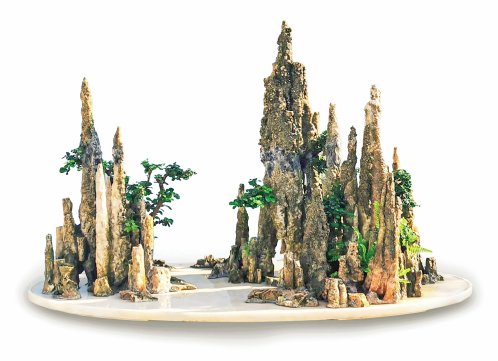
As one of the core categories within the traditional Chinese bonsai art system, stone bonsai (penjing) embodies the artistic essence of "shrinking a dragon into an inch and capturing the vast within the small," condensing the ethereal charm of natural landscapes and the myriad manifestations of heaven and earth into a confined tray. It achieves an ultimate fusion of natural authenticity and human craftsmanship, carrying the philosophical thought and spiritual pursuit of "unity of heaven and humanity and integration of emotion and scenery" in traditional Chinese aesthetics, serving as a concrete expression of Chinese landscape aesthetic culture. The author has been deeply engaged in bonsai art creation and theoretical research for over forty years. In the practical exploration of stone bonsai, the author has consistently adhered to the core creative principles of "learning from nature, prioritizing conception; adapting techniques to materials, seizing opportunities to shape; form following intention, scenery emerging from emotion; borrowing scenery to express emotion, integrating emotion and scenery." By deeply integrating traditional bonsai crafting techniques, classic modeling paradigms, regional cultural characteristics, and personal humanistic sentiments, the author has systematically studied the core essentials of stone bonsai creation and diverse artistic expressions. This has led to a series of practical explorations and theoretical accumulation for the inheritance, innovation, and localized development of traditional stone bonsai art.
I. Establishing the Artistic Conception and Framing the Composition: Guided by Intent, Shaped by Context
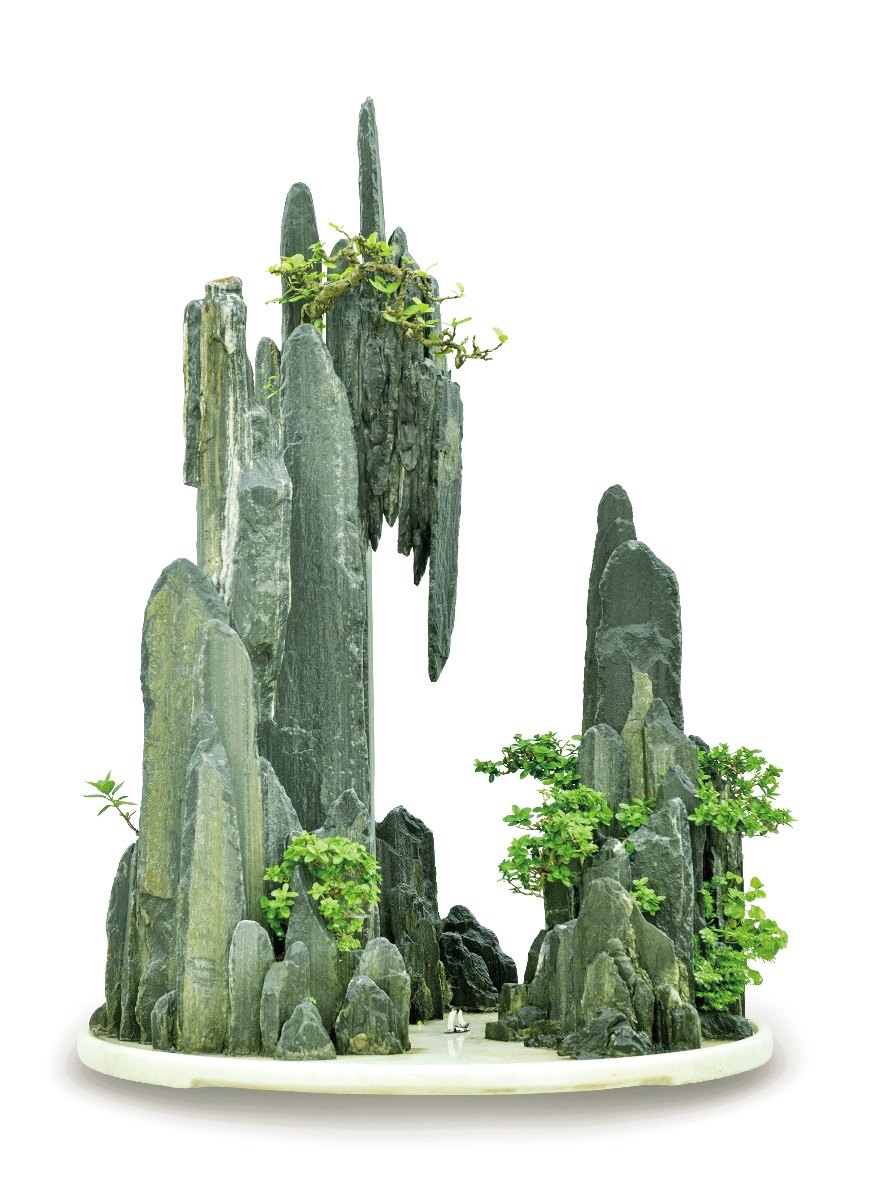
Establishing the artistic conception and framing the composition based on context are the primary guidelines and fundamental prerequisites for creating landscape bonsai. Traditional Chinese art has always championed the principle that "intent precedes the brush, and the painting's essence endures beyond its execution." Similarly, landscape bonsai creation is by no means a mere stacking or splicing of stones; rather, it follows a creative logic of "first establishing the mood, then constructing the landscape; using emotion to guide the scenery, and conveying emotion through the scenery," seamlessly integrating subjective aesthetic sentiments with objective mountain and water forms. The conception of a bonsai must balance the natural form with the human spirit—it should align with the stone's inherent texture, shape, color, and aura, without violating its nature through forced arrangement, while also incorporating the creator's aesthetic insights and emotional aspirations, achieving a mutual resonance between scene and sentiment.
Different expressions of artistic conception require corresponding classic compositional layouts to be realized, which also form the core basis for shaping landscape bonsai. In creative practice, it is essential to strictly adhere to the aesthetic principles of the "Three Distances Method" from traditional Chinese landscape painting, flexibly applying five classic foundational layout forms: the Host-Guest style, the Solitary Peak style, the Confrontation style, the Multi-Peak style, and the Embracing style. These construct a layered, dynamic, and vivid three-dimensional landscape: First, the Host-Guest style, where the main peak stone serves as the central feature, with accompanying stones as subordinate elements—clear in hierarchy, complementary in size and height, and enhancing spatial depth and rhythmic contrast through interplay. Second, the Solitary Peak style, where a single stone stands alone as a peak, with upright and rugged lines, concise and refined form, exuding a sense of ethereal solitude, noble elegance, and refined landscape aura. Third, the Confrontation style, where two peaks face each other across water, balanced in momentum and echoing one another, recreating the natural splendor of "two green mountains standing opposite each other," fostering a spatial tension that is both open and contained, majestic and precipitous. Fourth, the Multi-Peak style, where a range of peaks undulates continuously, staggered in height, alternating in density, and orderly in openness and closure, vividly reproducing the grandeur and majesty of vast mountain ranges. Fifth, the Embracing style, where peaks encircle and embrace one another, with inward and gentle mountain contours, gathering and circulating aura, creating a serene, deep, subtle, and evocative landscape mood.
In addition, diverse landscape forms such as the Cliff style, Precipice style, Cave style, Island style, and Figurative style each have their own rules and unique merits, collectively constructing an artistic space within a tiny tray that encompasses thousands of miles of natural scenery, allowing a miniature scene to fully display the myriad charms of natural landscapes.
II. Material Selection and Shaping: Crafting with the Stone, Creating Natural Perfection
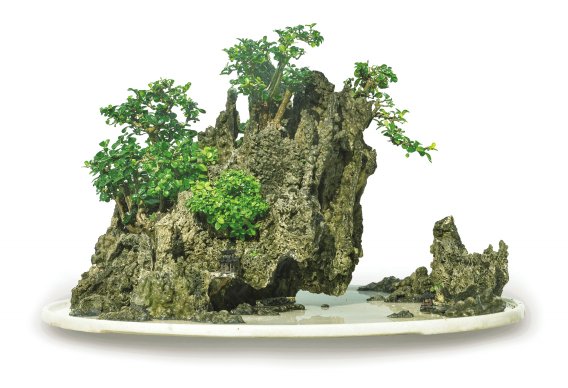
Material selection and shaping are critical steps in establishing the structure of a stone bonsai, directly determining the foundational texture and artistic style of the work. Stone selection must adhere to the traditional aesthetic standards of "thinness, wrinkles, perforations, and transparency," while also considering the coordination and unity of stone shape, texture, color, and grain to ensure a cohesive and harmonious overall stone quality. Incorporating the ecological and resource characteristics of Hainan, the author prioritizes local high-quality stones such as volcanic rock, sea mother rock, and dam rock in the creative process. Their texture, color, and grain closely align with the delicate and warm features of southern landscapes, infusing the bonsai with a rich regional natural essence.
The shaping process consistently upholds the core principle of "preserving natural charm while minimizing artificial carving," employing traditional techniques such as sawing, grinding, carving, and maintenance to the fullest extent. This approach retains the original texture and natural appeal of the stone, accurately simulating the natural traces of wind and rain erosion and water flow, while avoiding the artificiality and rigidity of excessive carving. As much as possible, it achieves the effect of "though man-made, it appears as if naturally formed," laying a foundation of natural authenticity for various compositional forms. Whether it is the upright prominence of a solitary peak, the majestic symmetry of opposing peaks, or the undulating continuity of multiple peaks, all rely on the natural form of the stone to shape the design, following the stone's inherent characteristics to create the landscape.
Joining, bonding, and layout design are core processes in the formation of stone bonsai and key steps in implementing various landscape forms. Joining must follow the principles of coherent mountain contours, seamless flow of energy, and interconnected veins, adjusting spatial logic according to different layout forms: the host-guest style emphasizes the use of auxiliary stones to highlight the main peak's grandeur, reinforcing the primary-secondary relationship; the embracing style precisely controls the curvature of peaks to create an inward, energy-gathering ambiance; the multi-peak style organizes the direction of mountain ranges to develop a continuous and expansive rhythmic flow. At the same time, breaking free from the limitations of a single form, the creative approach flexibly extends techniques for distinctive stones, achieving "tailor-made" landscapes: the cliff-hanging style extends the main stone body over a certain water surface area, creating a steep, overhanging, and precarious yet stable posture, breaking the constraints of flat composition; the island style uses blank space to suggest water, with scattered islets and rocks surrounded by water and mountains, evoking the delicate charm of Jiangnan water towns or coastal regions; the combined versatile style integrates features of multiple layout forms, selecting stones and creating landscapes according to the environment, achieving diverse meanings and endless artistic effects in a single scene. The bonding process balances stability and concealment, carefully crafting winding shores and deep valleys, reasonably reserving blank spaces in the landscape, using emptiness to contrast substance and fostering interplay between the two, further elevating the landscape imagery of various compositional forms and making the scenery appear more distant and enduring.
III. Plant Arrangement and Ornamental Accents: Enhancing the Scene and Adding Vitality
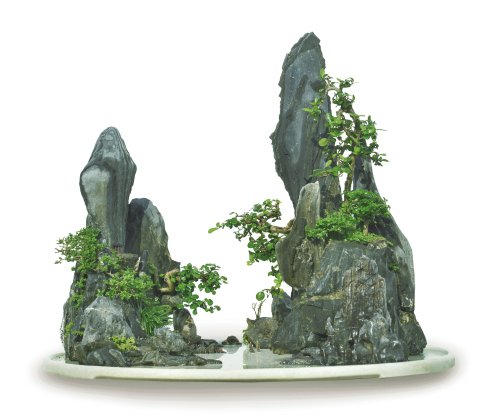
Plant arrangement and ornamental accents are key steps in elevating the artistic conception of stone bonsai and imbuing the bonsai with vitality. In creation, the author consistently adheres to the core principle of "stone as the main body, plants as the supplement," avoiding plants overpowering the main subject. For planting, bonsai materials such as *Bolan*, *Xianglan*, *True Cypress*, *Shou Niangzi*, and *Pearl Grass*—which are small in form, highly adaptable, and tolerant of poor soil—are selected. They are planted according to the mountain's natural contours and the composition layout, achieving a harmonious interplay of tree and stone, combining strength with softness for a mutually complementary effect. The scale of planting strictly follows the traditional proportion guideline of "a ten-foot mountain with a foot-tall tree, and an inch-tall horse with a fraction of a man," using small vegetation to adorn the rocks. This not only adds natural vitality to the rugged stones but also enhances the realism and layering of the landscape's artistic conception. Of course, when depicting close-up or partial scenes, the technique of "large trees in the foreground with distant mountains as a backdrop" can be appropriately employed, offering viewers ample room for imagination.
For ornamental accents, the principle of "just enough, perfectly placed" is upheld. Accessories such as pavilions, houses, boats, figures, and small bridges are skillfully positioned in line with the bonsai's composition and thematic conception: a solitary peak paired with a reclusive figure highlights a sense of refined seclusion; a confrontational arrangement with boats shuttling back and forth adds a lively, dynamic touch to the landscape; an island setting with a waterside pavilion evokes a leisurely and serene atmosphere. These tiny accessories serve to highlight the landscape theme and convey humanistic sentiments, ensuring that the bonsai not only embodies the form of mountains and waters but also carries the charm of human culture, achieving an artistic height where form and spirit are united, and the conception is profound.
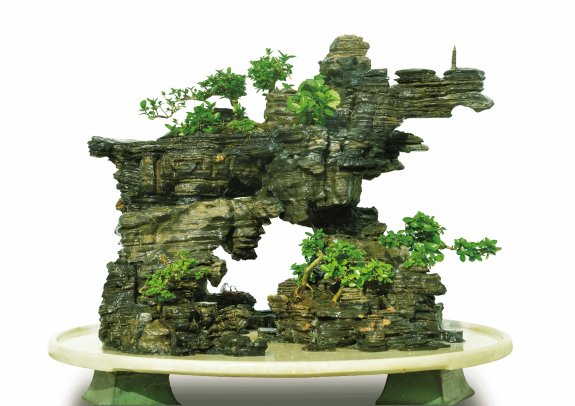
IV. Comprehensive Artistic Expression: Integrating Techniques to Forge the Soul, Inheriting and Innovating
From the perspective of comprehensive artistic expression, the core charm of stone landscape bonsai lies in the deep integration and symbiotic coexistence of diverse landscaping forms, traditional techniques, artistic conception creation, and regional culture, constructing an artistic system rich in layers and profound in connotation. At the technical level, classic Chinese landscape painting texture strokes (cunfa) are skillfully incorporated into the carving and shaping of stones, with appropriate strokes selected based on the characteristics of the mountain forms, endowing the stone textures with the charm of brush and ink and a natural feel, achieving a cross-disciplinary fusion of bonsai art and traditional painting and calligraphy. At the level of artistic conception, relying on a variety of landscaping forms, diverse aesthetic expressions such as majestic grandeur, elegant tranquility, precipitous wonder, and expansive openness are realized, transcending the mere replication of natural landscapes and elevating the art into a vehicle for emotion and thought. At the cultural level, rooted in traditional classic forms, local Hainan specialty stones, regional mountain and water landscapes, and humanistic temperament are integrated, allowing traditional stone landscape bonsai art to take root in regional cultural soil, blending classical charm with southern characteristics, further enriching the cultural connotation and regional identity of bonsai art.
Within a small space of stones, the essence of heaven and earth is condensed; a single pot of craftsmanship carries the lineage of Chinese culture. The creation of stone landscape bonsai is a systematic artistic endeavor, requiring meticulous attention to every detail in the entire process of material selection, shaping, layout, planting, embellishment, naming, and display, with each step interconnected and pursued to perfection. Over forty years of creative practice and theoretical exploration have led the author to deeply realize: the inheritance and innovation of traditional stone landscape bonsai art can only be achieved by consistently following natural laws, refining artistic forms, upholding humanistic intentions, and integrating techniques to forge the soul. Only then can artistic masterpieces be created that embody both form and spirit, possess profound artistic conception, and exude vibrant vitality, allowing traditional Chinese stone landscape bonsai art to uphold tradition while innovating through generations, and to radiate renewed vigor and vitality in the course of the times.
