
A Comprehensive Discussion on Bonsai Art (Part II)
A Brief Exploration of the Aesthetic Categories and Aesthetic System Construction of Tree-and-Stone Bonsai
By Chuangang Liu · July 18, 2026
As a core category within the Chinese bonsai art system, known for its inclusiveness and representativeness, tree-and-stone bonsai integrates trees as the skeletal framework, rocks as the spiritual support, and containers as the vessel for artistic conception. It deeply fuses the ethereal charm of natural landscapes, the vibrant vitality of vegetation, and the creator's emotions, techniques, and aesthetic aspirations into a confined space. Compared to single-tree bonsai, which focuses on individual tree styling and solitary expression, or landscape bonsai, which emphasizes stacked rocks to form mountains and leverages terrain for scenery, tree-and-stone bonsai completely breaks the creative limitations of a single element. It achieves a symbiotic fusion and mutual reinforcement between the vitality of trees and the character of rocks, constructing a classic miniature natural aesthetic form that "compresses a dragon into an inch, yet spans a thousand miles in a foot," thereby establishing a unique artistic category. Against the backdrop of contemporary bonsai art's commitment to preserving tradition while fostering innovation and development, precisely clarifying the core aesthetic categories of tree-and-stone bonsai and establishing a scientific, systematic, complete, and standardized exclusive aesthetic system not only deeply organizes and refines traditional Chinese bonsai aesthetic theory but also serves as the core driver for standardizing contemporary tree-and-stone bonsai creation, typifying landscape construction, and professionalizing appreciation and evaluation. This article, based on the author's decades of bonsai creation practice, industry research experience, and artistic exploration insights, systematically deconstructs the multi-layered aesthetic connotations of tree-and-stone bonsai and deeply explores pathways to construct an aesthetic system that embodies both traditional heritage and contemporary value.
The aesthetic categories of tree-and-stone bonsai are deeply rooted in the traditional Chinese philosophical concept of "harmony between heaven and humanity" and the aesthetic view of "learning from nature." Through millennia of inheritance and accumulation, as well as iterative exploration by generations of bonsai practitioners, four core aesthetic categories have gradually crystallized: beauty of form, beauty of artistic conception, beauty of rhythm, and beauty of character. These four categories progress layer by layer, interlock, support each other, and form an organic unity, constructing a complete and closed-loop aesthetic logic system for tree-and-stone bonsai. This system is also the core characteristic that distinguishes it from other bonsai categories and traditional plastic arts.
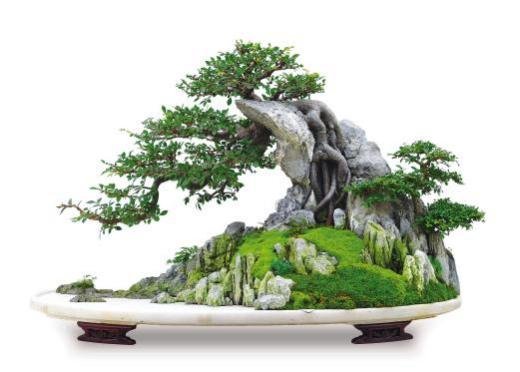
Species: Elm, Yingde Stone
Dimensions: 100cm × 65cm
Artist: Jiang Yangyan
I. Morphological Beauty
Morphological beauty is the most fundamental aesthetic category of tree-and-stone bonsai and the primary vehicle for viewers' aesthetic perception, consistently adhering to the core creative principle of "learning from nature, yet surpassing it." The key to the morphological beauty of tree-and-stone bonsai lies in the harmonious coexistence, balanced proportion, and seamless integration of the four core elements: trees, stones, containers, and stands. The shaping of trees emphasizes a rugged and ancient main trunk, with branches that are twisted and gracefully extended, featuring clear primary and secondary distinctions, appropriate density, and well-layered branch supports. The roots are coiled and exposed, firmly anchored, highly restoring the natural posture of ancient trees in the wild that have weathered wind and rain, fully showcasing the tree's intrinsic form. The selection and arrangement of stones adhere to the traditional aesthetic standards of "thinness, wrinkling, perforation, and translucency" while also incorporating contemporary bonsai shaping aesthetics of "uniqueness, ugliness, elegance, and charm." Stones with ancient textures, striking forms, and profound character are chosen to complement the trees in height, hardness, and softness—whether standing as solitary peaks, reclining to conceal secluded spots, or leaning to create dynamic momentum—vividly evoking natural landscapes of layered peaks, towering cliffs, and distant mountains. The container and stand, as the supporting body and extension of the artistic conception, must align perfectly with the overall spirit of the tree and stone in terms of shape, size, color, texture, and material style. The container is simple and understated, never overpowering the main elements, while the stand is minimalist and antique, precisely enhancing the artistic atmosphere. The overall work avoids redundant accumulation or imbalance in weight, using exquisite craftsmanship to recreate the appearance of natural landscapes, achieving the artistic realm of "though man-made, it seems naturally formed," laying the foundation for the overall aesthetic of tree-and-stone bonsai.
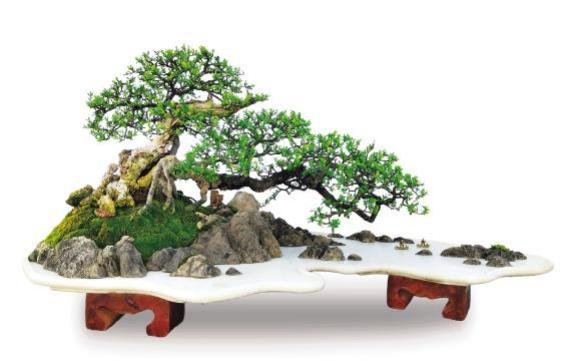
Species: Iron Whip, Turtle Pattern Stone
Dimensions: 150cm × 70cm
Artist: Zhou Tianyong
II. Artistic Conception Beauty
Artistic conception beauty is the core aesthetic category of tree-and-stone bonsai, serving as the soulful carrier of the creator's artistic cultivation and spiritual sentiment, and representing the essential elevation of bonsai appreciation from tangible object perception to abstract spiritual insight. Traditional Chinese art has always emphasized artistic conception, valued verve, sought blank-leaving, and stressed "meaning beyond form, conception born in the heart." The creation of tree-and-stone bonsai is by no means a mechanical replication or simple imitation of natural landscapes, but rather a subjective artistic creation and emotional expression by the creator, who "learns from nature and derives inspiration from the heart." Relying on profound natural observation and artistic accumulation, the creator skillfully arranges trees and stones, employs virtual-real spatial blank-leaving, and balances dynamic and static scenery to condense the landscapes of the mind and heart into the confined soil of the pot. Within this limited space, they evoke distant and ethereal artistic conceptions such as ancient temples hidden in deep mountains, pine-scented breezes along riverbanks, layered emerald valleys, and boundless skies and seas. The blank spaces in the pot allow viewers to imagine swirling clouds, flowing streams, and vast wilderness, using finite tangible scenes to generate infinite imaginative space and aesthetic meaning. This enables viewers to observe the form, grasp the rhythm, appreciate the posture, and feel the emotion, immersing themselves in the supreme aesthetic experience of blending emotion with scenery and forgetting both self and object. This is precisely the core artistic charm of tree-and-stone bonsai, transcending the craft of shaping itself and spanning time and space.
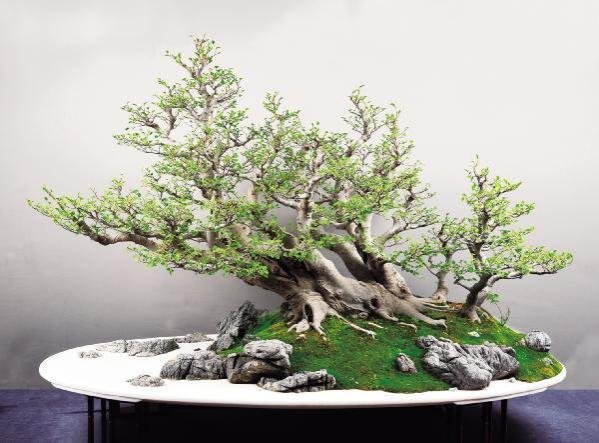
Species: Hackberry, Yingde Stone
Dimensions: Pot length 115cm
Artist: Xiao Yixing
III. Rhythmic Beauty
Rhythmic beauty is a unique dynamic aesthetic category of tree-and-stone bonsai, endowing the static, solidified bonsai forms with vibrant life rhythms and a well-paced sense of cadence. Although tree-and-stone bonsai is a static art of display, it conceals the endless rhythms of nature's cycles and the compositional principles of spatial landscaping. The staggered heights and tilts of branches, the interplay of density and openness in foliage, the contrasts of light and shade, and the undulating, varied arrangement of rocks create an artistic rhythm of cadence and tension on a visual level. The seasonal cycles of trees—their withering and flourishing, the shifts of cold and warmth—and the weathered textures and aged qualities of rocks, accumulated over time, harbor a hidden dimension of temporal flow and the unceasing rhythm of life. The aesthetic principles of unity in opposites—balancing hardness and softness, motion and stillness, density and sparseness, decay and renewal, concealment and exposure—completely break free from the rigidity and stagnation of static forms. This allows the work to exhibit dynamic vitality within orderly structure, and to reveal exuberant life amidst serene composure, vividly interpreting the cyclical, ever-growing life force of all things in nature. It endows the silent landscape within the pot with a flowing, vibrant, and enduringly moving artistic rhythm.
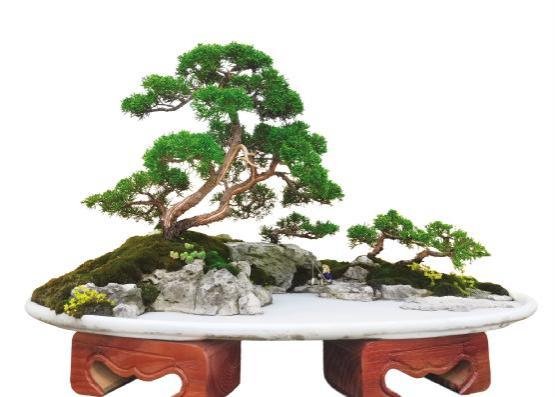
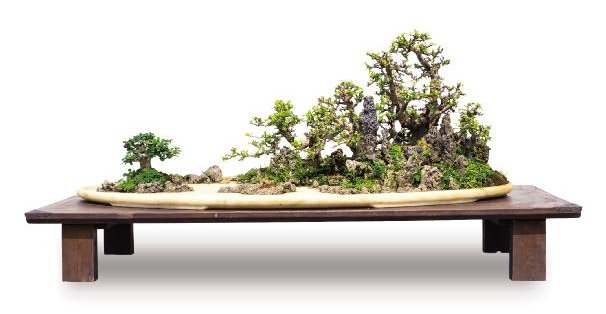
Species: Juniper (Shimpaku), Turtle-pattern Stone
Specifications: Pot length 80cm
Artist: Xiong Changrong
IV. The Beauty of Spirit and Character
The beauty of spirit and character represents a profound aesthetic category in tree-and-stone bonsai, embodying a deep fusion of traditional Chinese humanistic spirit with the intrinsic qualities of natural objects, and standing as a significant realm within the aesthetic system of tree-and-stone bonsai. Within the context of millennia-old Chinese culture, tree species commonly used in bonsai creation—such as pine, cypress, elm, maple, and Hainan bolan—have long served as core vehicles for literati and scholars to express aspirations and convey emotions through objects. The unyielding resilience of the green pine, the vigorous and proud character of the verdant cypress, and the firmness and steadiness of bolan all carry the lofty spiritual qualities of the noble person: uprightness, indifference to fame and fortune, adherence to one's true nature, and open-minded composure. The beauty of spirit and character in tree-and-stone bonsai never depends on intricate or elaborate forms or ornate scenery; rather, it lies in the spiritual bearing and humanistic connotations embodied by natural objects: ancient trees with gnarled roots entwined around precarious rocks, standing proudly after enduring wind and rain, exemplifying the indomitable and self-renewing vitality of the Chinese nation; mountains and stones standing silently, steady and profound, retaining their inner charm after years of erosion, interpreting the cultured person's calm composure, simplicity, and patriotic sentiments. The creator deeply integrates their own artistic cultivation, humanistic spirit, life perspective, and patriotic feelings into the creation, ensuring that each tree-and-stone bonsai work possesses both the form of natural landscapes, the soul of traditional literati, and the charm of Eastern culture, truly achieving a high degree of unity between craftsmanship technique and spiritual essence.
Based on the four core aesthetic categories of form, rhythm, artistic conception, and spirit and character, a systematic aesthetic system for tree-and-stone bonsai can be constructed, integrating "form, rhythm, conception, and soul" into a unified whole, forming a contemporary bonsai aesthetic and evaluation standard with clear hierarchy, rigorous logic, and unified criteria. With form as the foundation, precisely control the proportions of the work's composition, element arrangement, and natural texture presentation, solidifying the basic aesthetic foundation of bonsai; with rhythm as the pulse, adhere to spatial compositional rhythm and the natural rhythm of life, endowing the work with a lively and vivid artistic quality; with artistic conception as the core, deeply cultivate the interplay of emptiness and solidity and the creation of mood, expanding the space for aesthetic imagination and elevating the overall artistic tone of the work; with soul as the guiding principle, inherit the spirit of Chinese literati and traditional aesthetic spirit, granting the work enduring spiritual essence and cultural vitality. This aesthetic system firmly upholds the essential principles of traditional Chinese bonsai aesthetics while adapting to contemporary popular aesthetic trends and artistic creation needs, providing solid and systematic theoretical support for the creation, appreciation and interpretation, industry evaluation, and academic research of tree-and-stone bonsai.
Tree-and-stone bonsai serves as a vibrant carrier of China's excellent traditional horticultural culture and plastic aesthetics, embodying the Chinese people's worldview of conforming to and revering nature, their aesthetic view of the interplay between emptiness and solidity and the unity of form and spirit, and their humanistic view of virtue-bearing and steadfast character. In the process of inheriting and innovating contemporary bonsai art, only by adhering to the four core aesthetics and continuously perfecting a standardized and systematic aesthetic system can the miniature tray and basin carry the millennia-old Chinese cultural lineage, allowing the ancient art of tree-and-stone bonsai to iterate and innovate while preserving its roots, rejuvenate through generations of inheritance, and continuously showcase the unique artistic charm and enduring cultural value of Chinese bonsai aesthetics.
