
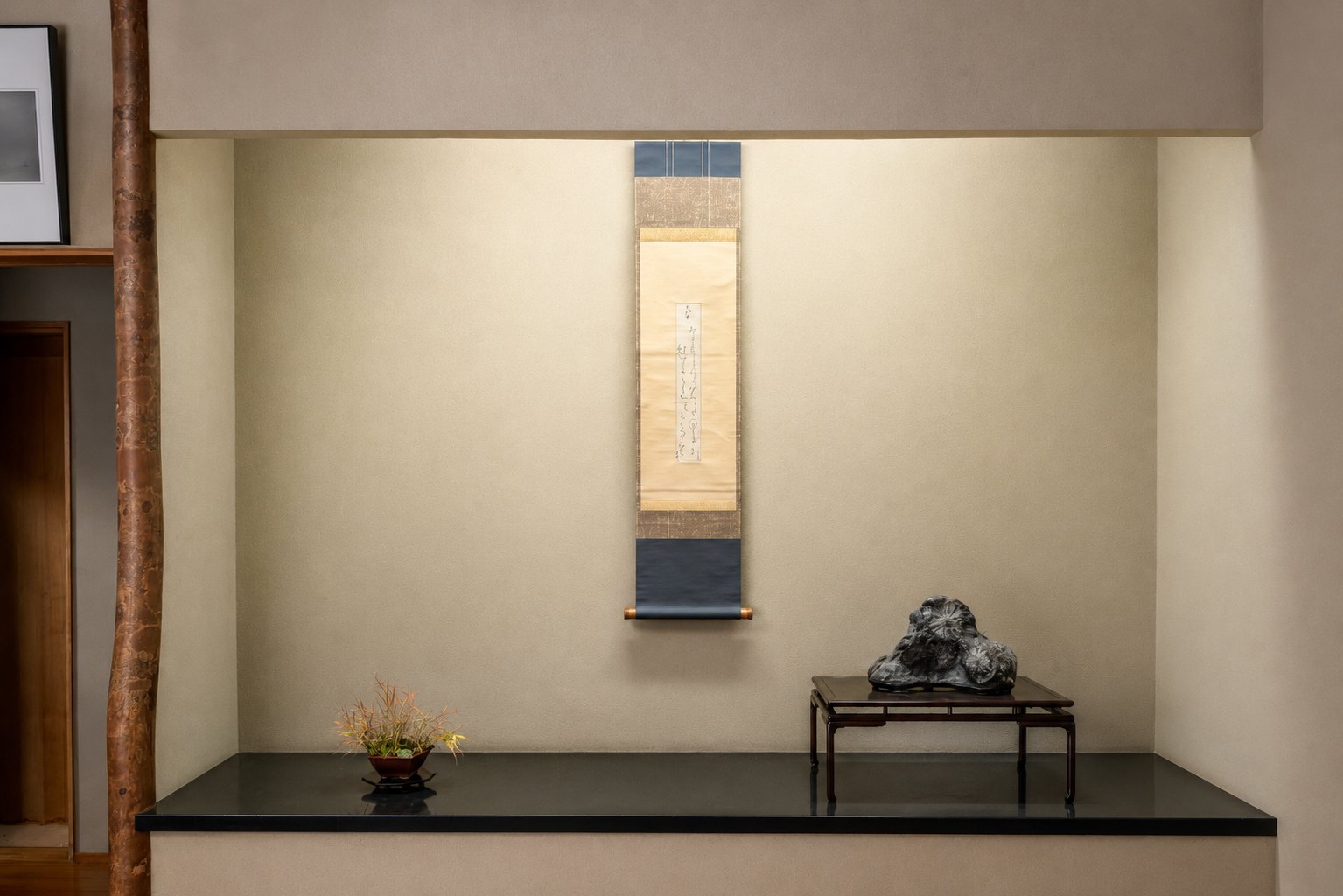
Suiseki: The Stone, Its Nature, and the Art of Its Display
Discover the Japanese art of suiseki and kazari through their history, aesthetics, classification, and display principles. This article explains how stones, daiza, suiban, and companion elements create balanced, meaningful compositions with nature.
By 勝讓武古 (Masaru Buko) · July 30, 2026
Forthcoming in: BCI Bonsai & Stone Appreciation Magazine 2026 Q4
Suiseki (Japanese: 水石, literally “water stone”) is the Japanese art of appreciating naturally formed stones whose shape, color, or surface suggests a natural landscape, although they may also evoke natural objects, animals, or human figures. According to the Nippon Suiseki Association, the term suiseki is understood as an abbreviation of sansui keiseki (“landscape-view stone”), while its written form (水石) is literally composed of the characters for “water” (sui) and “stone” (seki).
Characteristics
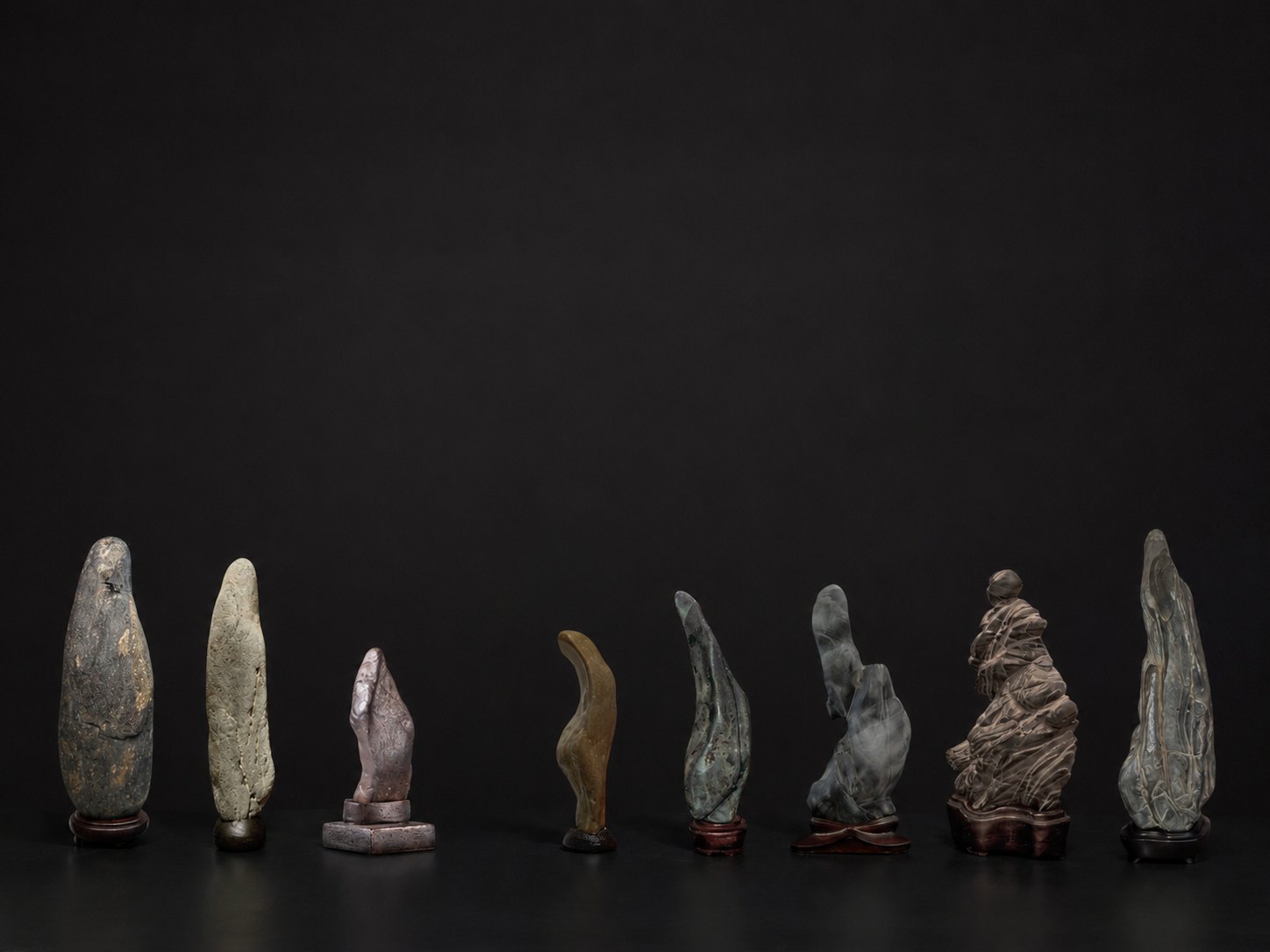
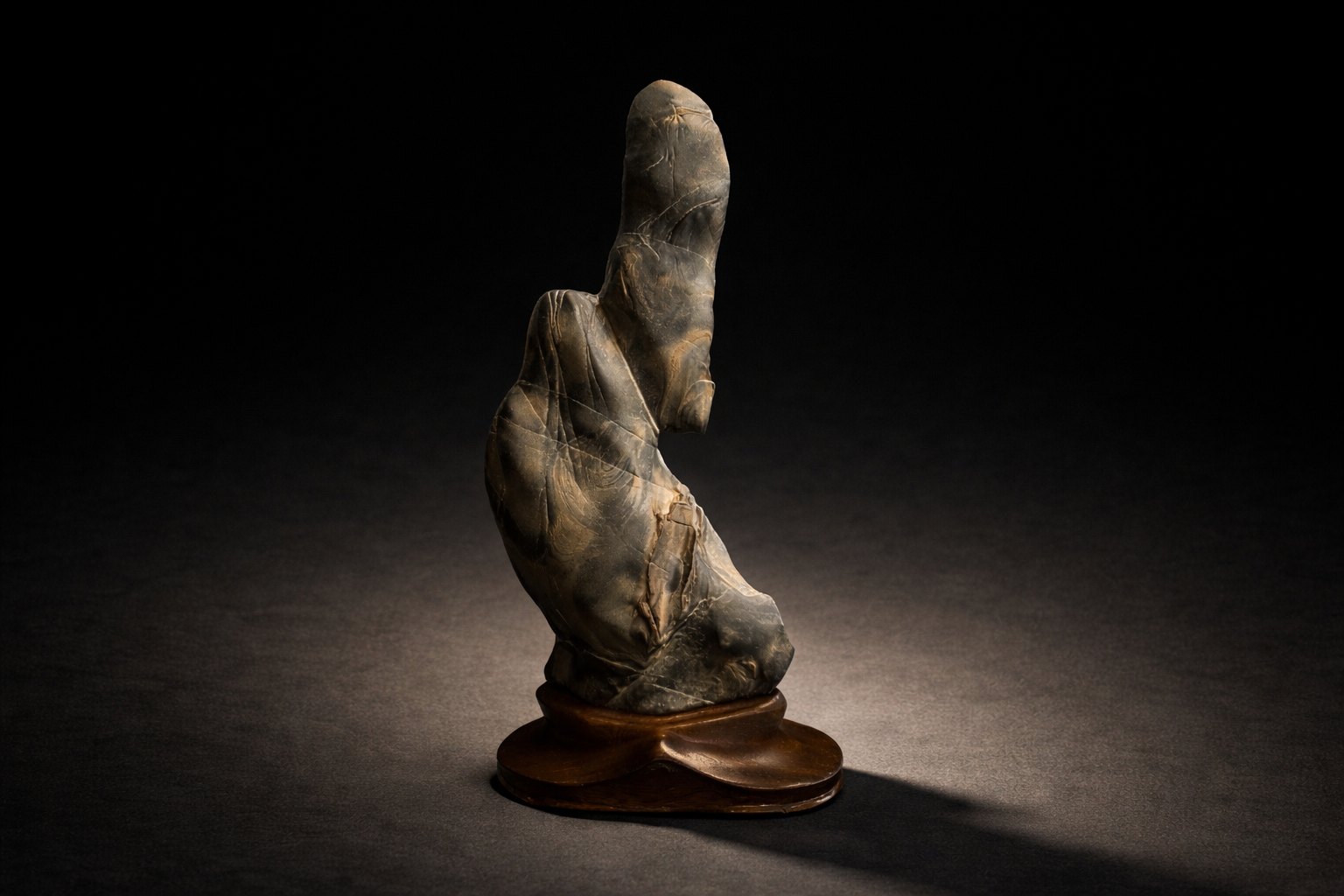
A suiseki is a completely natural stone that has not been artificially altered. Traditionally, it represents a landscape, although modern appreciation also accepts stones suggesting natural objects, animals, or human figures, provided they retain a clear connection with nature.
A suiseki should generally be small enough to be handled comfortably, ideally with one hand, or at most with both hands. If two people are required to lift it, the stone would normally be considered excessively large, except in the case of truly exceptional specimens. In China, however, it is not uncommon to find monumental viewing stones that require cranes for transportation.
Vincent T. Covello, who co-authored The Japanese Art of Stone Appreciation: Suiseki and Its Use with Bonsai with Yuji Yoshimura, recounts a traditional account according to which Sen no Rikyū (1522–1591), the renowned tea master who established the foundations of the Japanese tea ceremony (Sadō or Chadō), greatly appreciated suiseki and helped establish the practice of displaying a viewing stone in the tokonoma during the tea ceremony, placing a simple stone on a black, high-rimmed tray beneath the kakejiku (hanging scroll).
Suiseki may also be displayed alone as the central feature (Shuseki) of a tokonoma. On other occasions, it serves as a secondary or accompanying element to a main bonsai display. In this context, it is referred to as tenseki (添石, accompanying stone). Rather than acting as the primary subject, a tenseki is used to establish spatial depth, convey a sense of the natural environment, or complement the seasonal mood—spring, summer, autumn, or winter—evoked by the primary elements of the composition.
Today, there are two traditional ways to display a suiseki. One is on a custom-carved wooden stand known as a daiza. The other is in a large, shallow tray that evokes a more natural setting. These trays may be ceramic, called suiban, or metal—typically bronze—known as a doban.
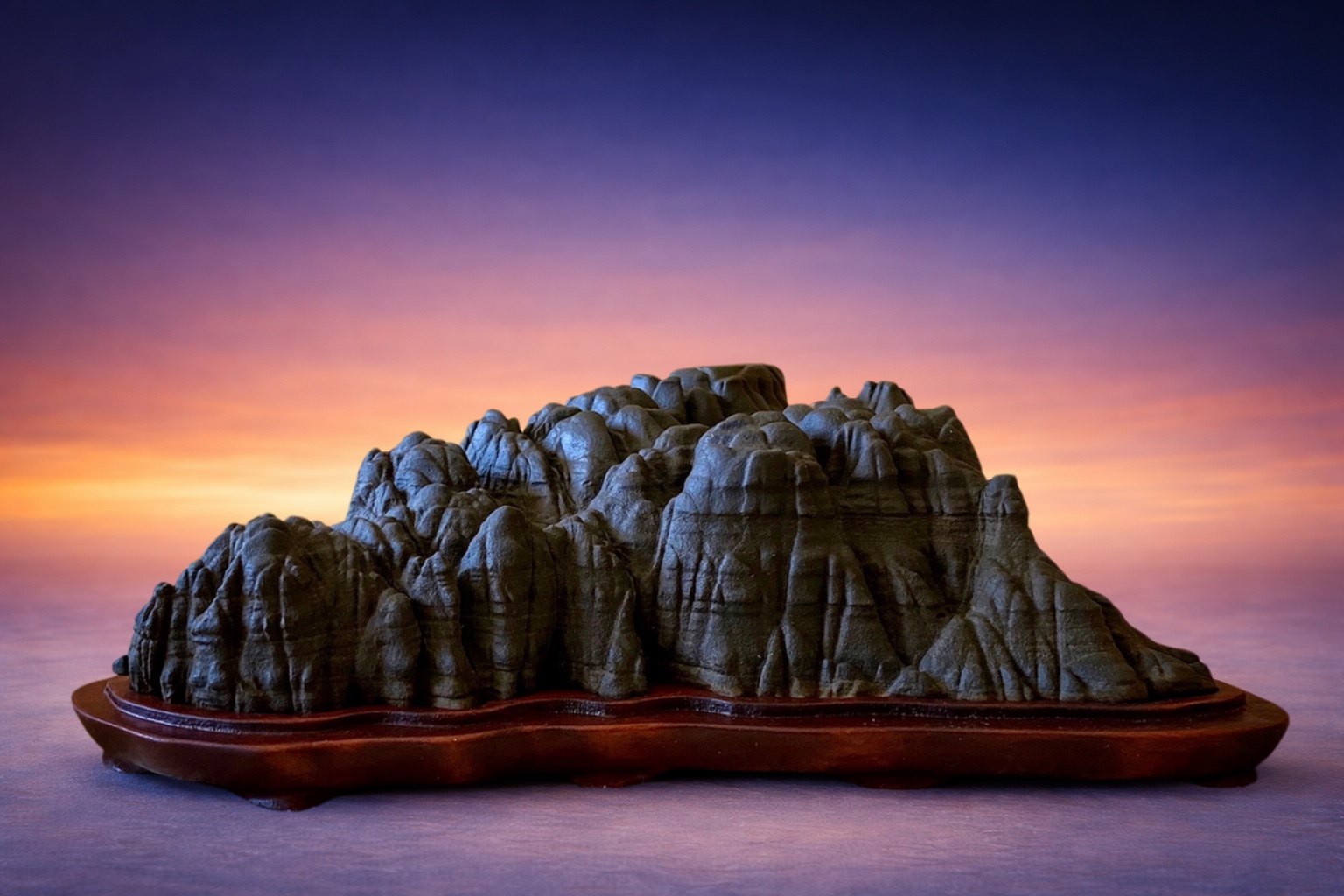
The world’s most important collections of viewing stones have traditionally been established in Japan, China—the birthplace of the broader tradition of stone appreciation from which suiseki descends—and Korea. During the 20th century, significant collections also began to emerge in countries such as Germany, the United States, Spain, Italy, the United Kingdom, and the Czech Republic. In many other Western countries, suiseki is a growing art form, attracting increasing interest, particularly among bonsai enthusiasts. In Spain, this tradition is represented by the Spanish Suiseki Association.
Outside Japan, viewing stones are known by different names according to their cultural tradition: shangshi in China, suseok in Korea, and, in English-speaking countries, landscape stones or viewing stones, terms commonly used to encompass the Japanese, Chinese, and Korean traditions.
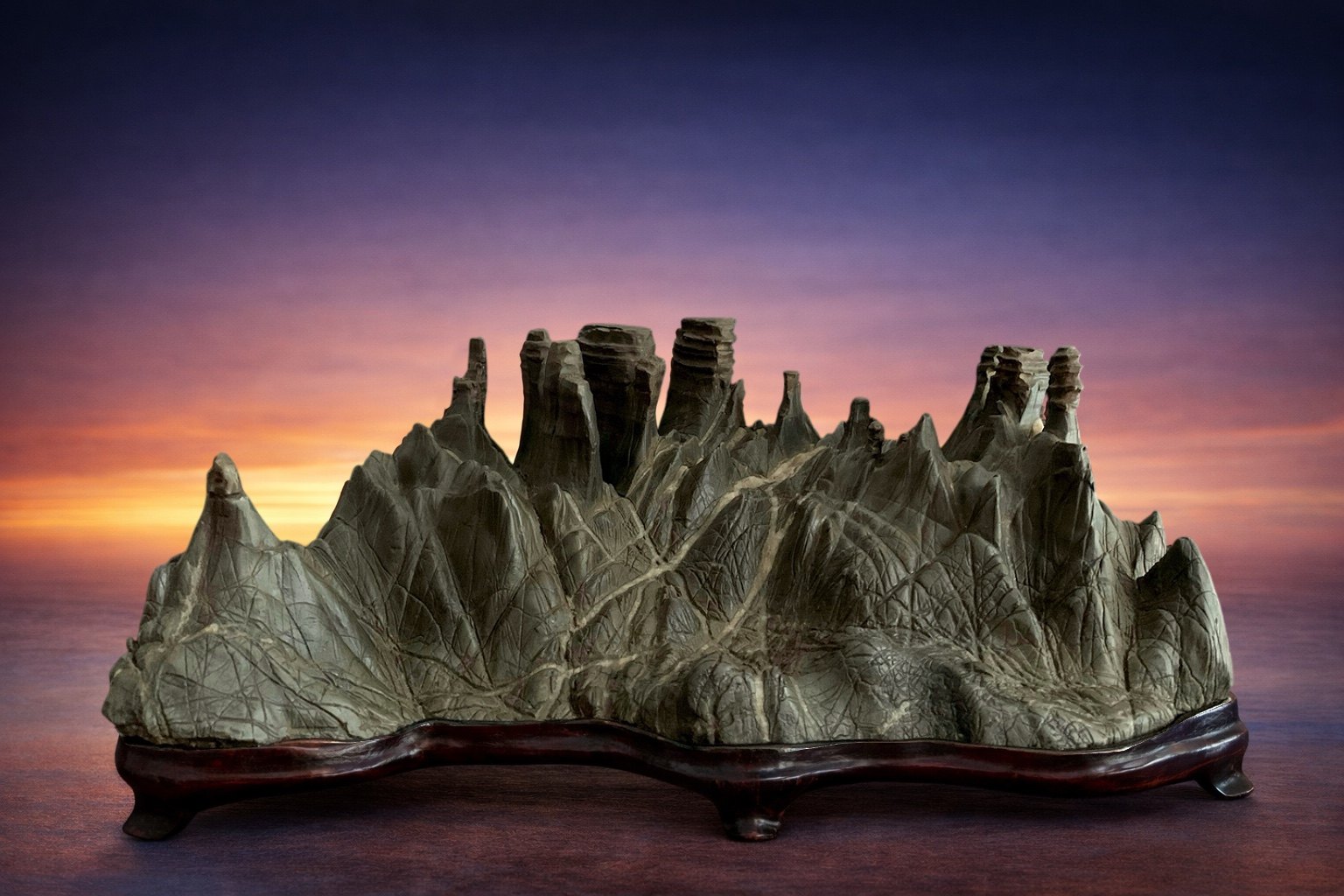
These stones evoke natural landscapes found in nature. Some of the following categories are not mutually exclusive and may be combined within the same suiseki, describing different aspects of the stone, such as its form, seasonal character, or other natural features. The following are some of the main categories. Since the full classification is extensive and beyond the scope of this article, readers interested in a comprehensive breakdown may consult the classic reference works on the subject, particularly those by Vincent T. Covello and Yuji Yoshimura.
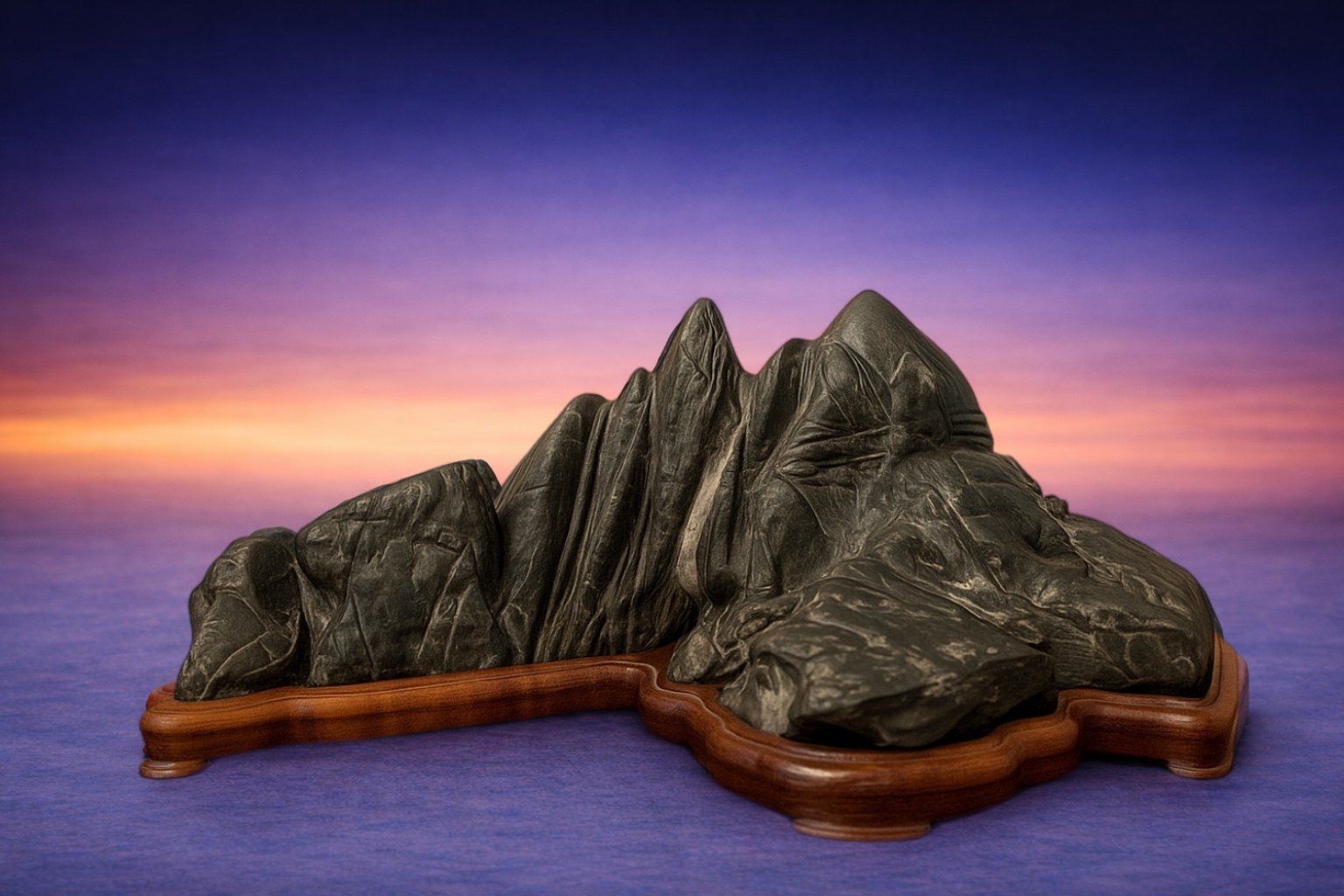
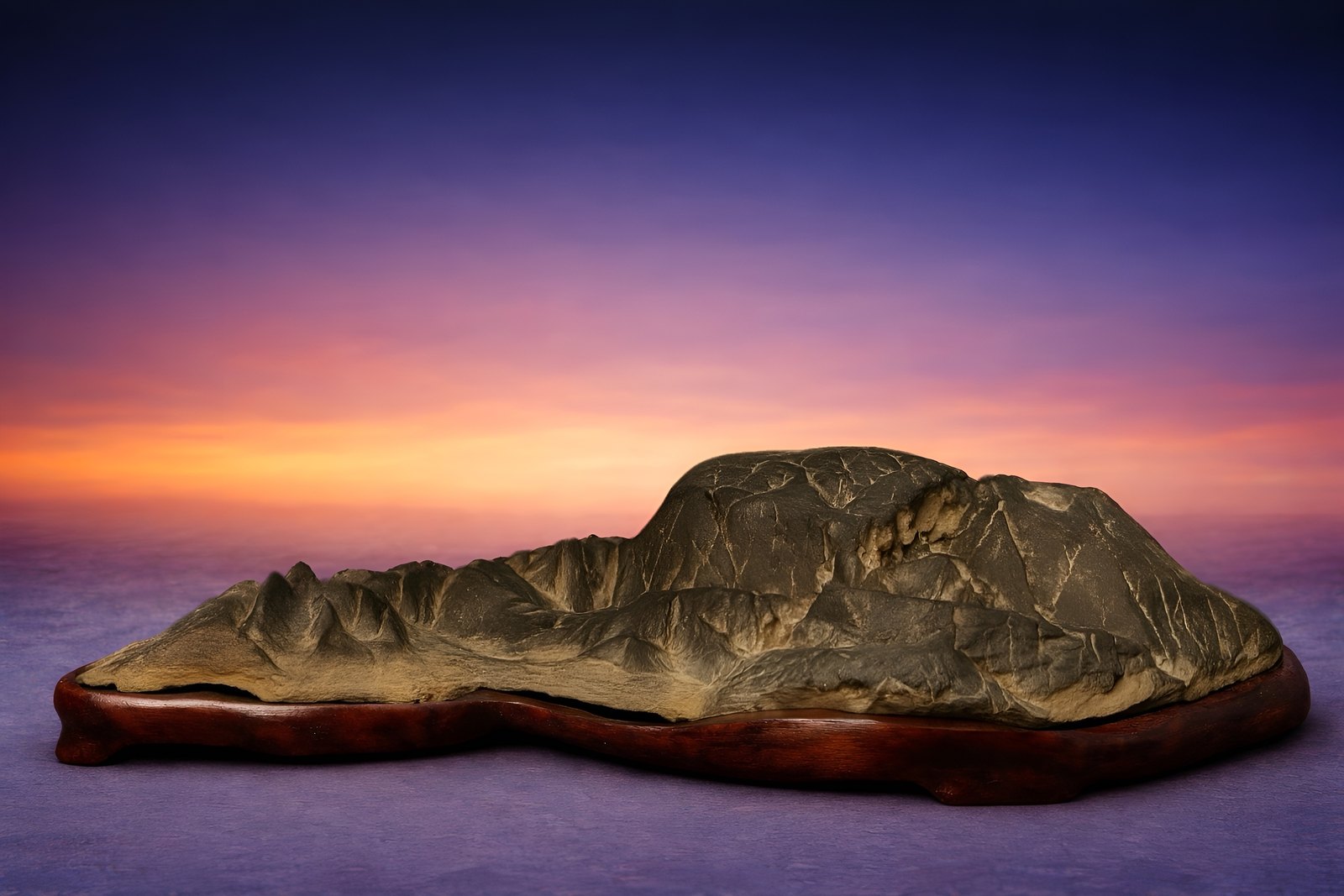
• Yamagata-ishi (Mountain Stones): Stones that resemble a single mountain or a mountain range. They are further classified according to viewing distance, the number of peaks, seasonal appearance, and other distinctive natural features.
• Toyama-ishi / Enzan-seki (Distant Mountain Stones): Stones suggesting mountains viewed from a great distance. (Both suffixes—ishi and seki—mean “stone”; see Naming Suiseki, below, for the distinction between the two.)
• Kinzan-seki (Near Mountain Stones): Stones representing mountains seen at close range, where relief, texture, and geological features are clearly visible.
• Kōhō-seki (Single-Peak Stones): Stones representing a mountain with one prominent summit.
• Nihō-seki (Two-Peak Stones): Stones suggesting either two separate mountains or a single mountain with two distinct peaks.
• Sampō-seki (Three-Peak Stones): Stones depicting three clearly separated peaks.
• Rempō-seki (Mountain Range Stones): After the traditional sequence of one, two, and three peaks (Kōhō-seki, Nihō-seki, and Sampō-seki), stones displaying a greater number of peaks are generally classified as Rempō-seki, representing a succession of mountains rather than a single summit.
• Sekkei-ishi (Snow-Covered Mountain Stones): Mountain stones whose white mineral inclusions evoke snow-covered landscapes.
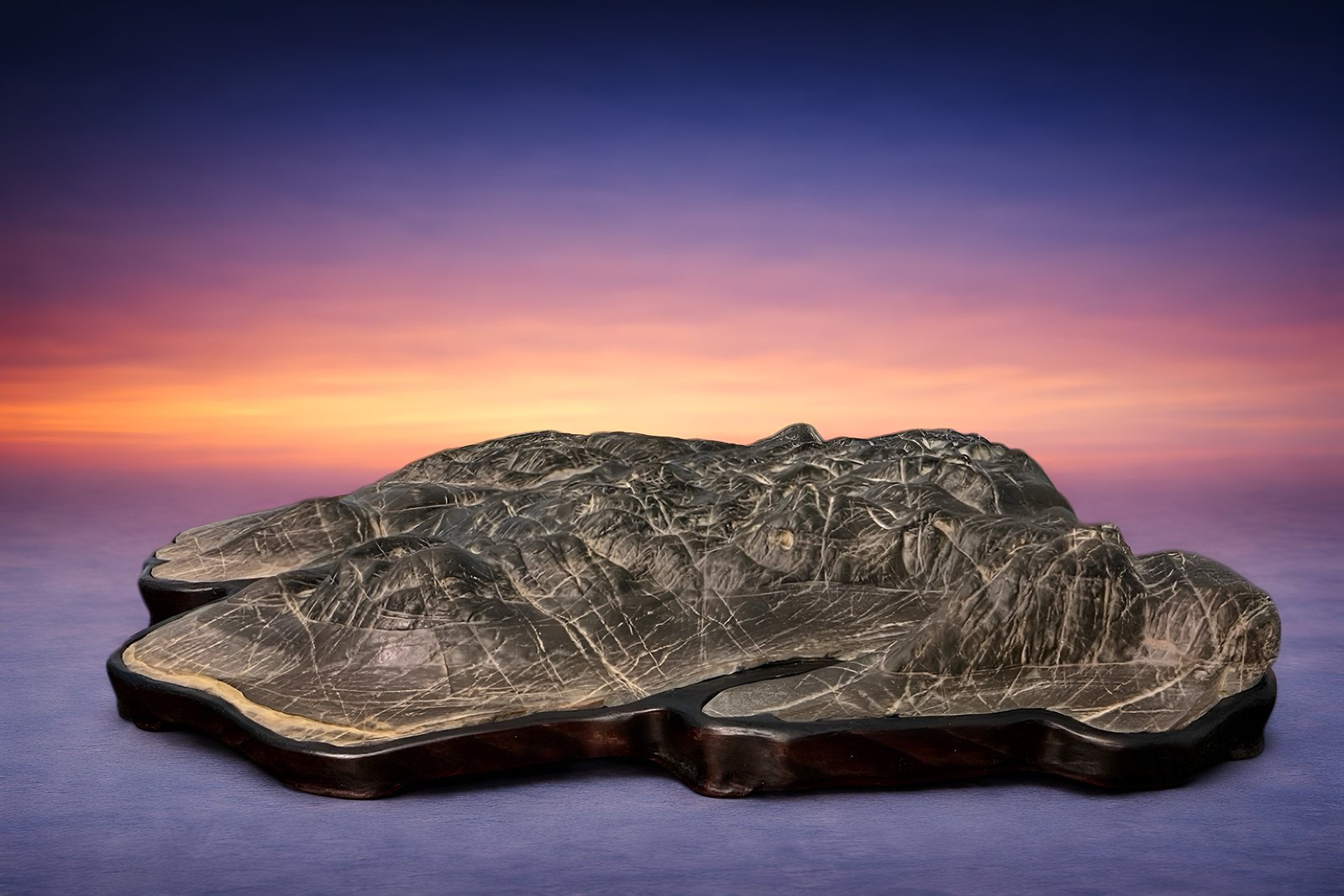
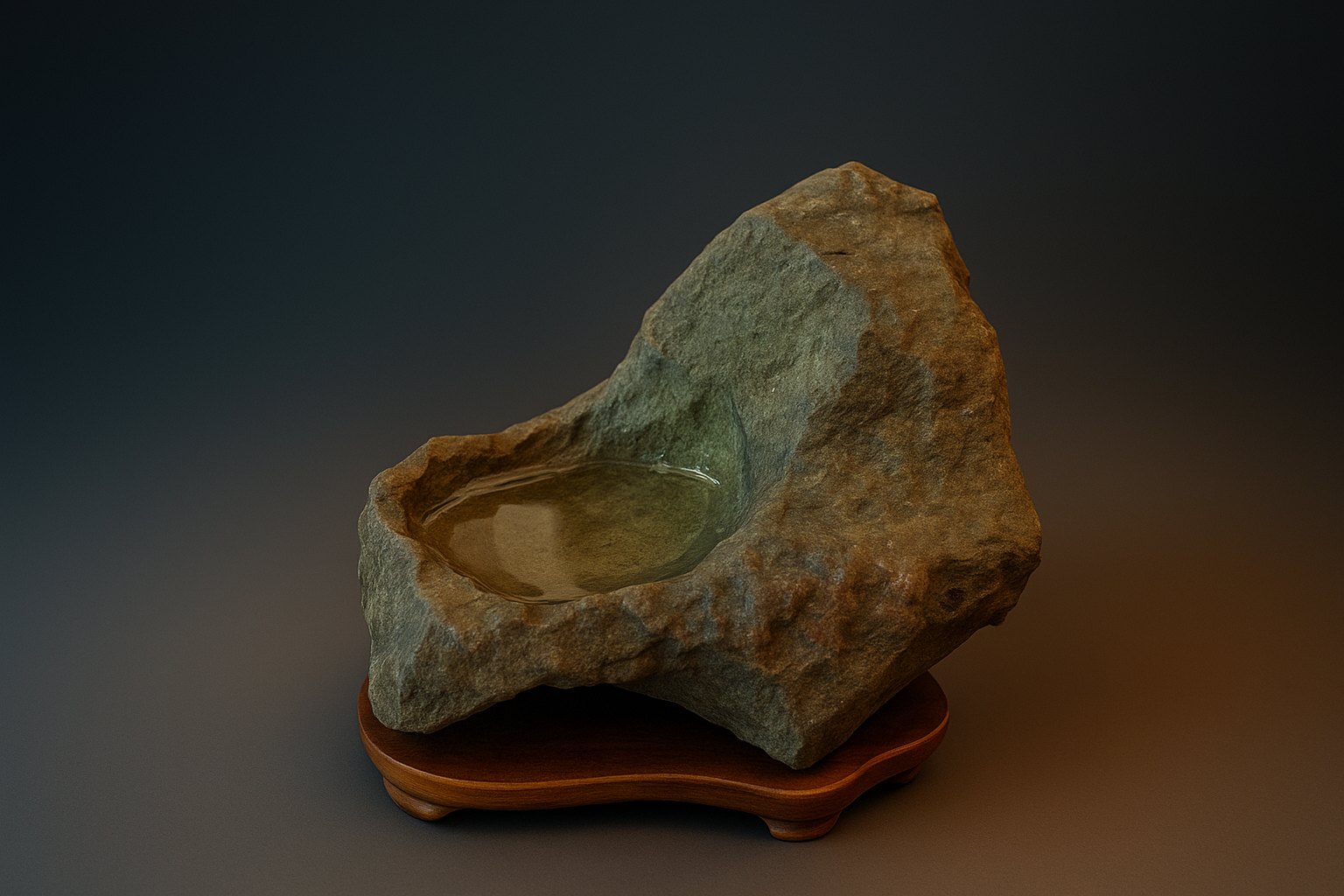
• Chi-seki / Mizutamari-ishi (Pool / Pond Stones): Stones featuring a distinct natural depression on their upper surface that holds water, evoking a mountain lake, pool, or pond. While landscape stones may be displayed either in a suiban or on a daiza, Chi-seki are normally presented on a daiza because the carved wooden base provides the stable, level support required to retain the water contained within the stone.
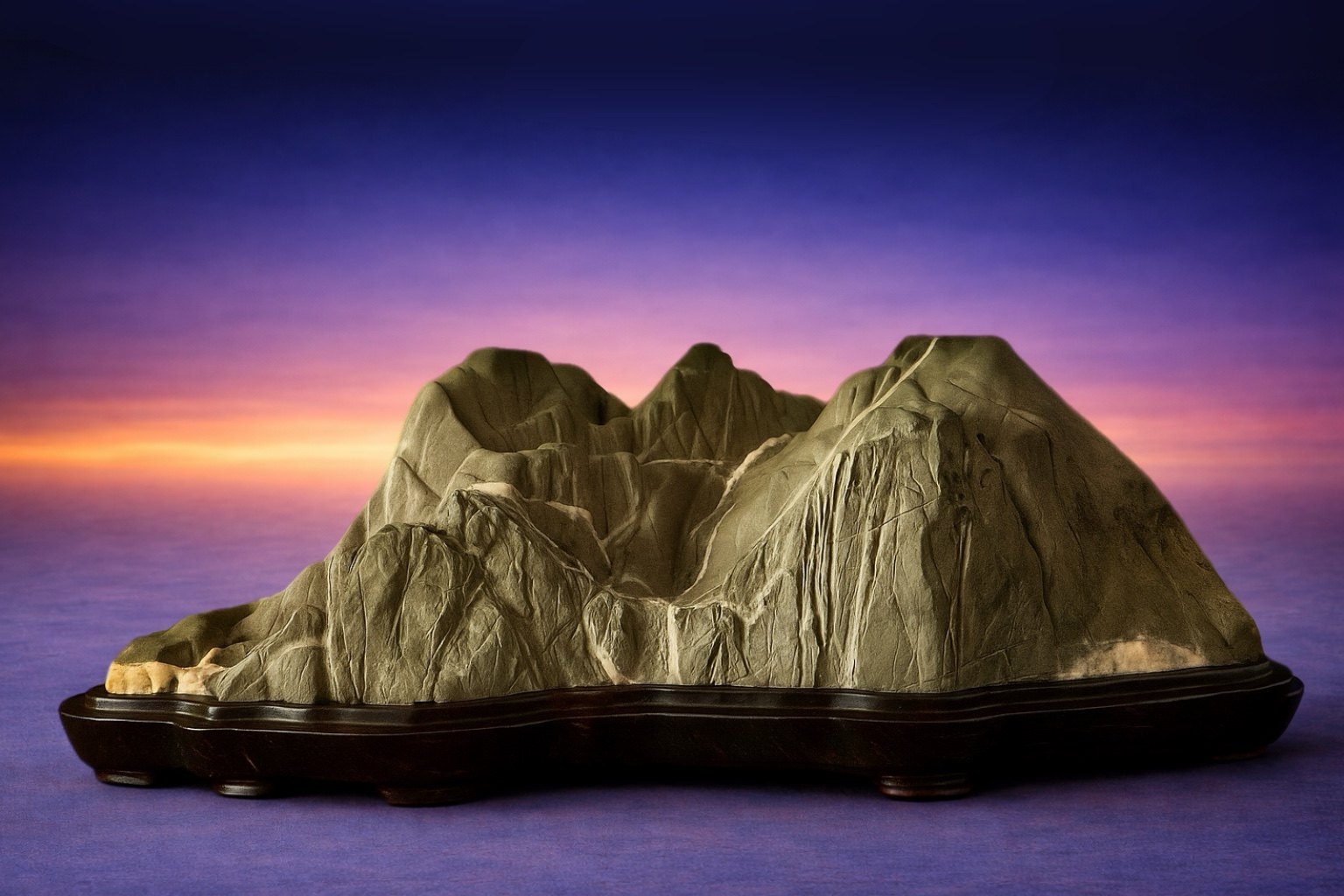
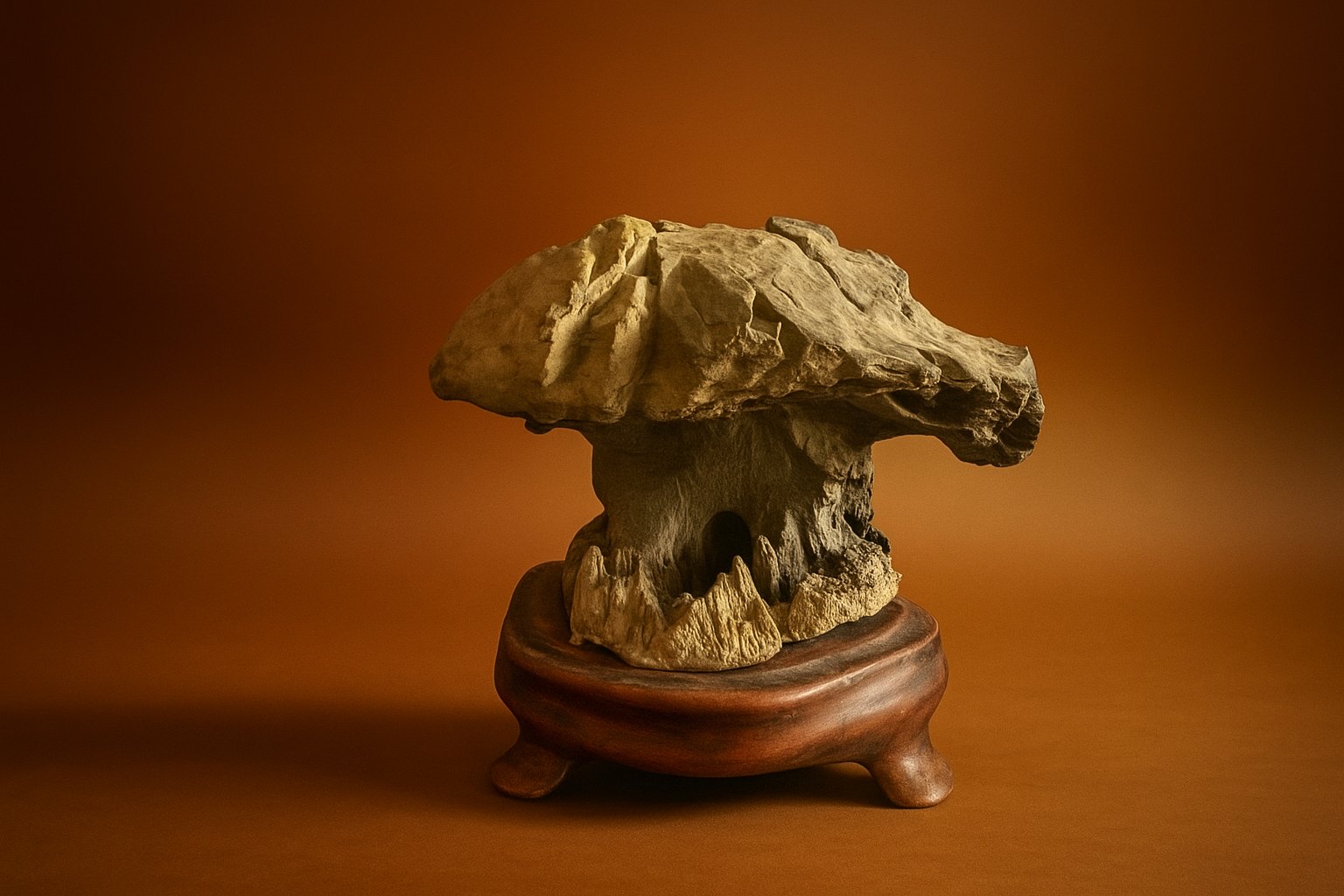
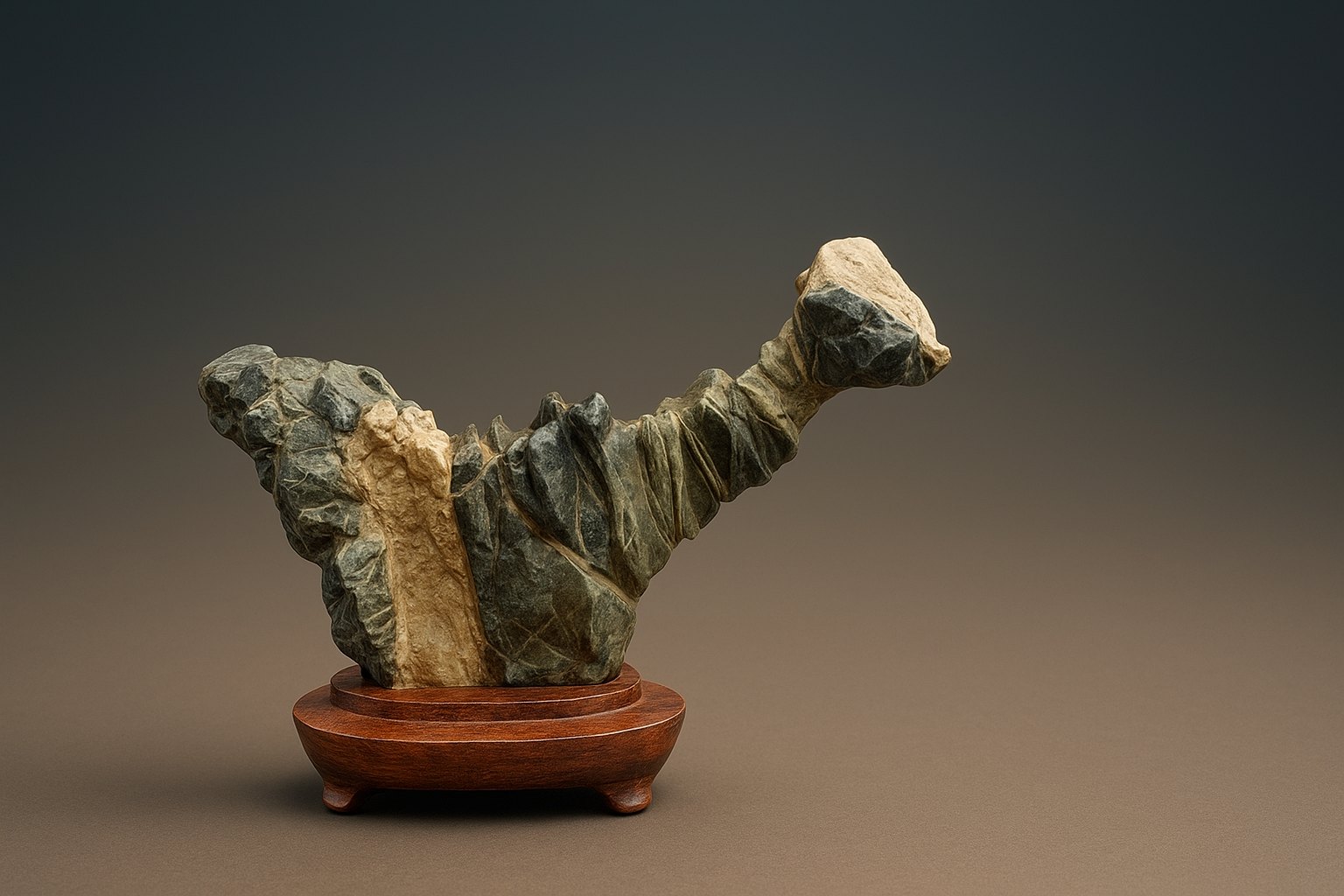
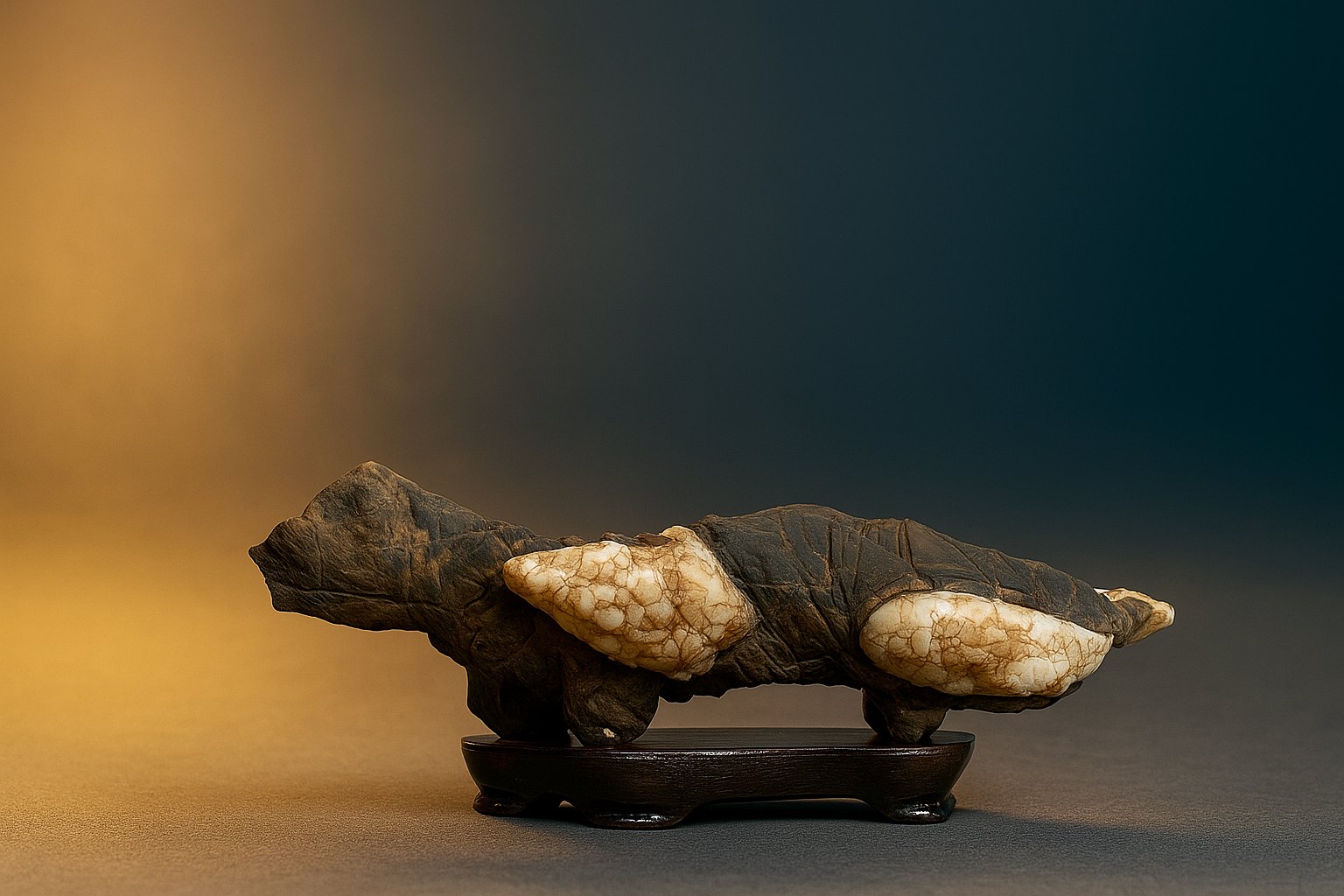
Keishō-seki (Object Stones)
This category includes stones whose shapes resemble natural objects. The finest examples do not reproduce the object exactly but instead suggest it through subtle lines and forms, leaving room for the viewer’s imagination.
Traditionally, ten principal categories are recognized, although some overlap. For example, bird, fish, and insect stones may also be regarded as specific forms of Dōbutsu-seki (Animal Stones).
• Yagata-ishi (House Stones): Stones that suggest rustic houses or traditional dwellings.
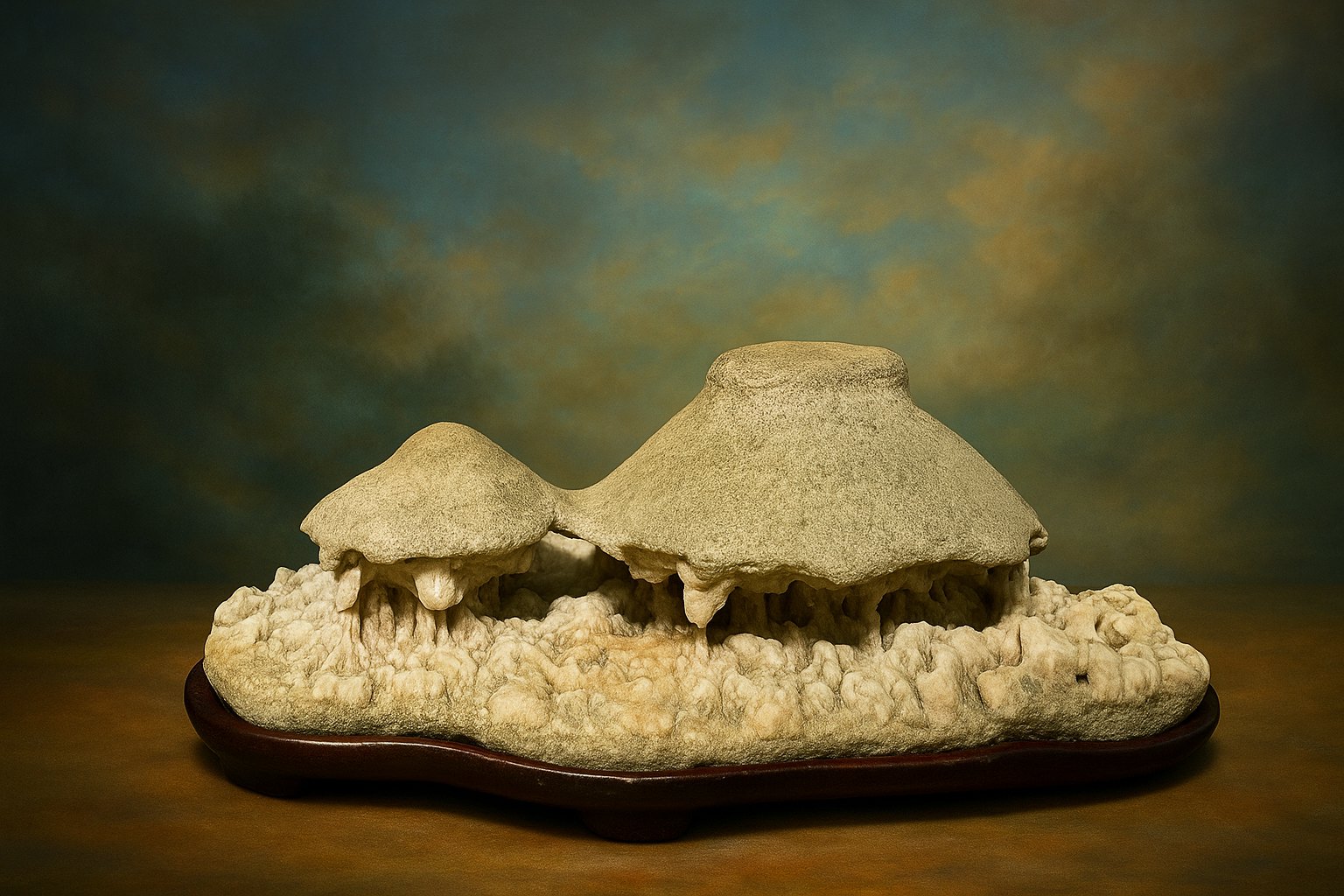
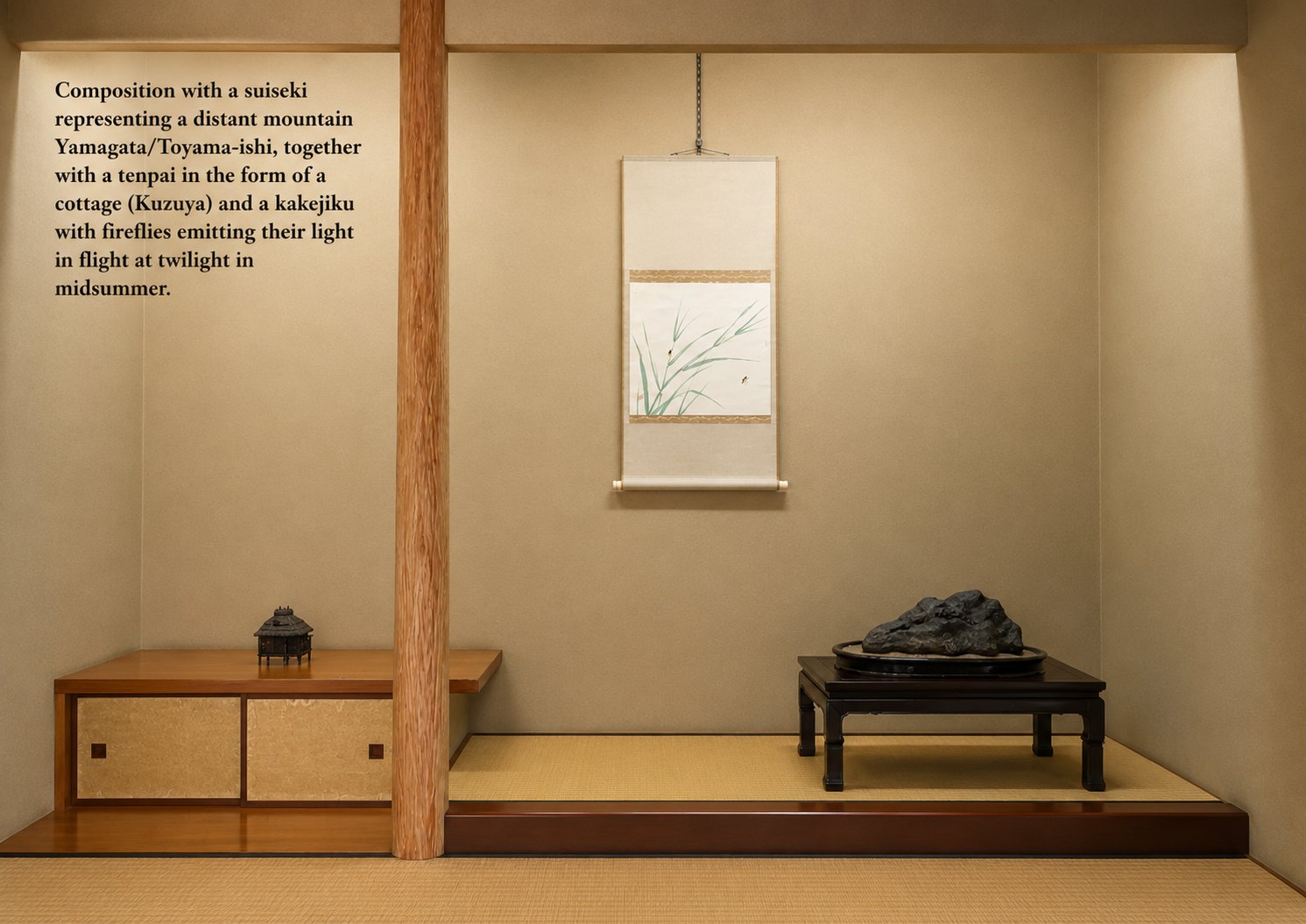
• Kuzuya-ishi (Thatched Cottage Stones): Stones resembling rural cottages with thatched roofs. Ideally, they display a rounded or triangular roof projecting above a weathered or hollowed base. Stones suggesting supporting pillars are especially valued.
• Funagata-ishi (Boat Stones): Stones resembling various types of boats, including wooden boats, rowing boats, and small fishing vessels.
• Hashi-ishi (Bridge Stones): Stones that evoke the form of a wooden or stone bridge.
• Dōbutsu-seki (Animal Stones): Stones suggesting the form of any animal.
• Torigata-ishi (Bird Stones): Stones resembling real or mythical birds.
• Mushigata-ishi (Insect Stones): Stones suggesting insects such as butterflies, dragonflies, crickets, or grasshoppers.
• Uogata-ishi (Fish Stones): Stones resembling fish, with koi and goldfish being especially admired.
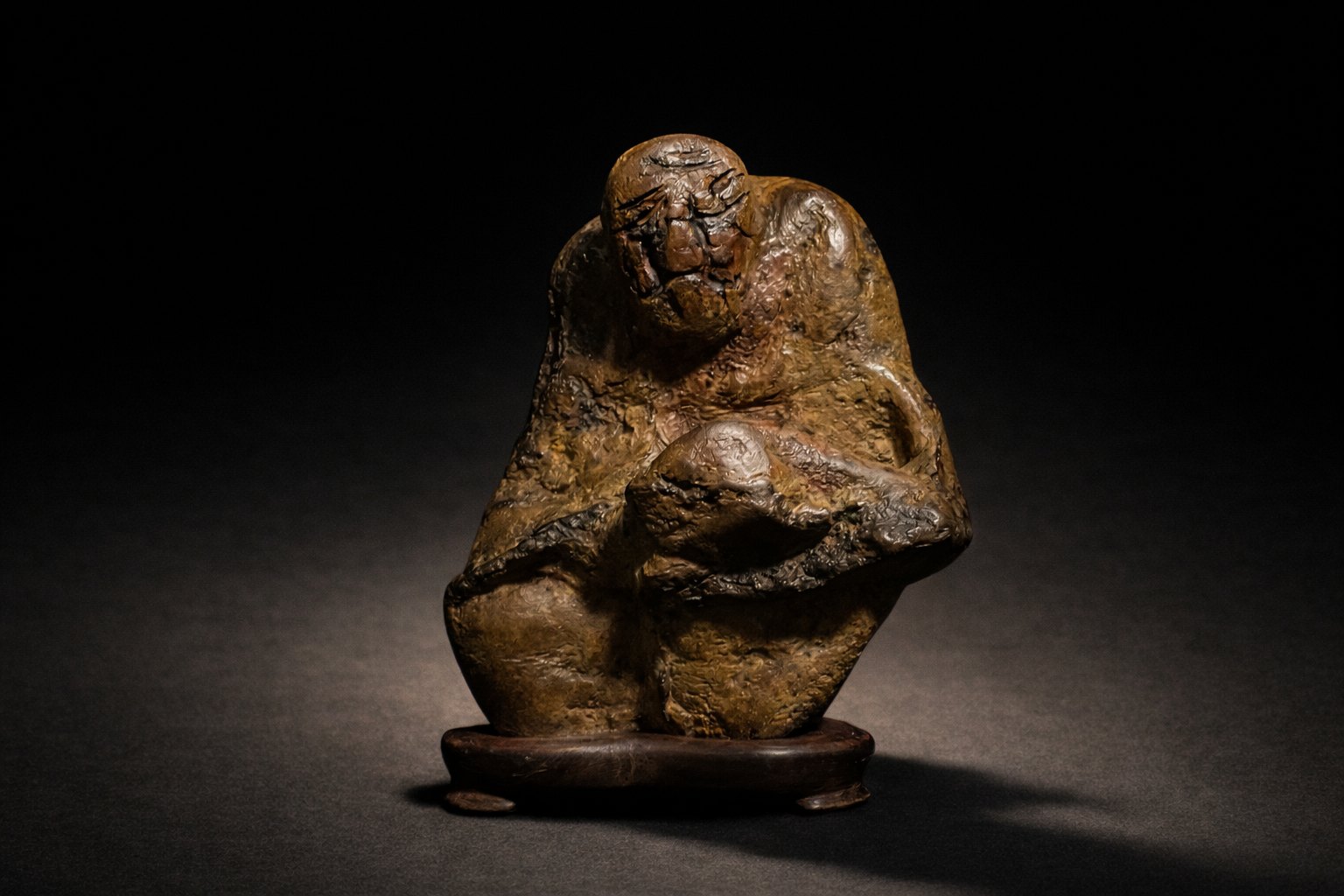
• Sugata-ishi / Jimbutsu-seki (Human Figure Stones): Stones suggesting human figures, such as fishermen, farmers, ladies, Buddhist monks, or even the Buddha. Stones evoking parts of the human body are also included in this category.
• Sankeishi-seki (Three-Object Stones): Stones that suggest three different objects when viewed from different angles.
Classification by Color (Shikisei-seki)
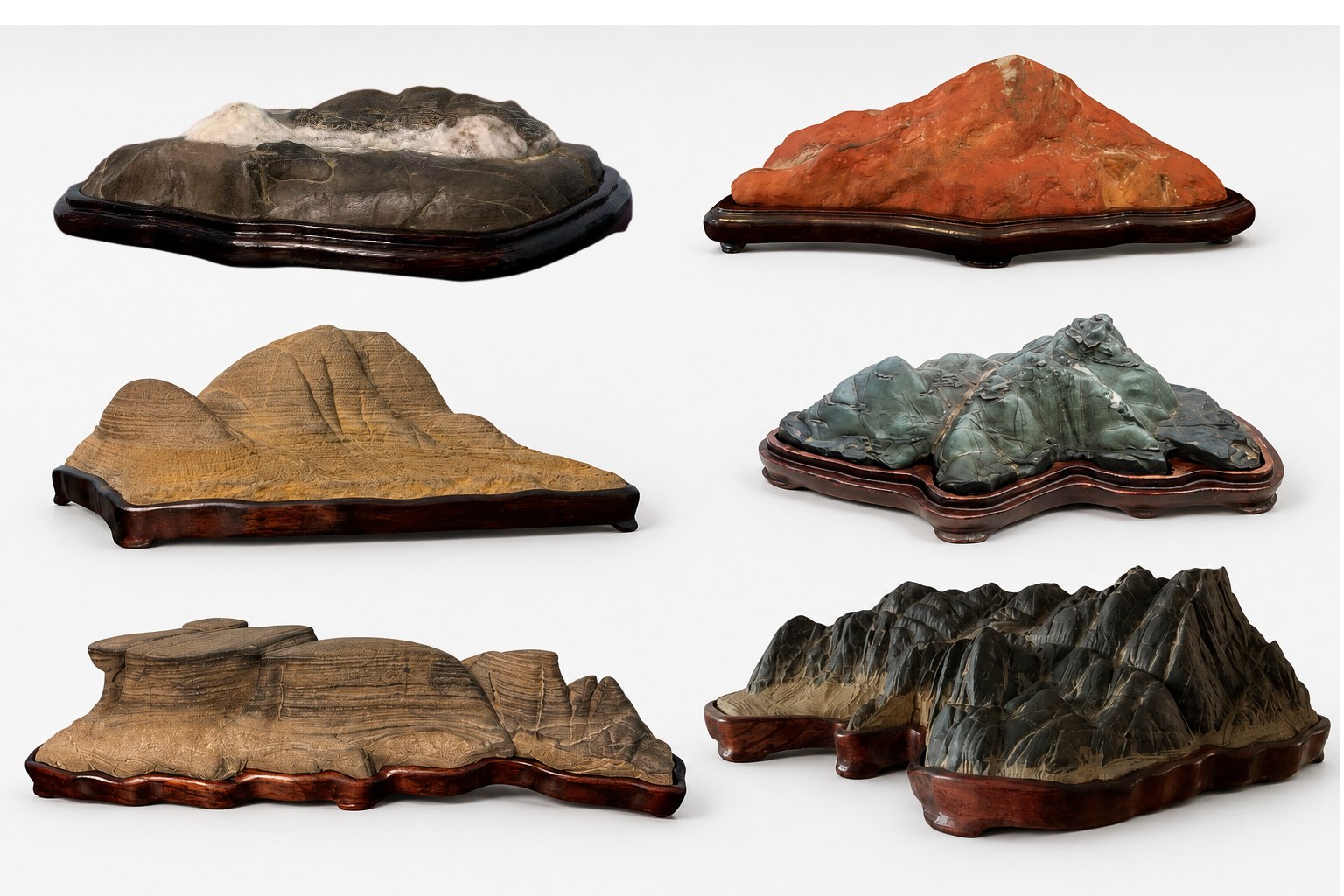
In the study and formal classification of suiseki, categorization based on predominant color or tonal combination is designated as Shikisei-seki.
While orthodox Japanese aesthetics have historically favored dark, charcoal, or deep black stones (Kuro-seki) for their capacity to evoke distance, austerity, and quietude (wabi-sabi), color serves a critical interpretive function when it directly suggests specific natural elements, seasonal transitions, or atmospheric phenomena.
Primary Tonal Categories
The traditional classification divides colored stones into the following formal categories:
• Kuro-seki / Kuro-ishi (Black or Dark Stones): The quintessential classical standard. Deep black, charcoal gray, or matte graphite surfaces absorb light uniformly, directing the viewer's focus toward form, contour, and spatial depth.
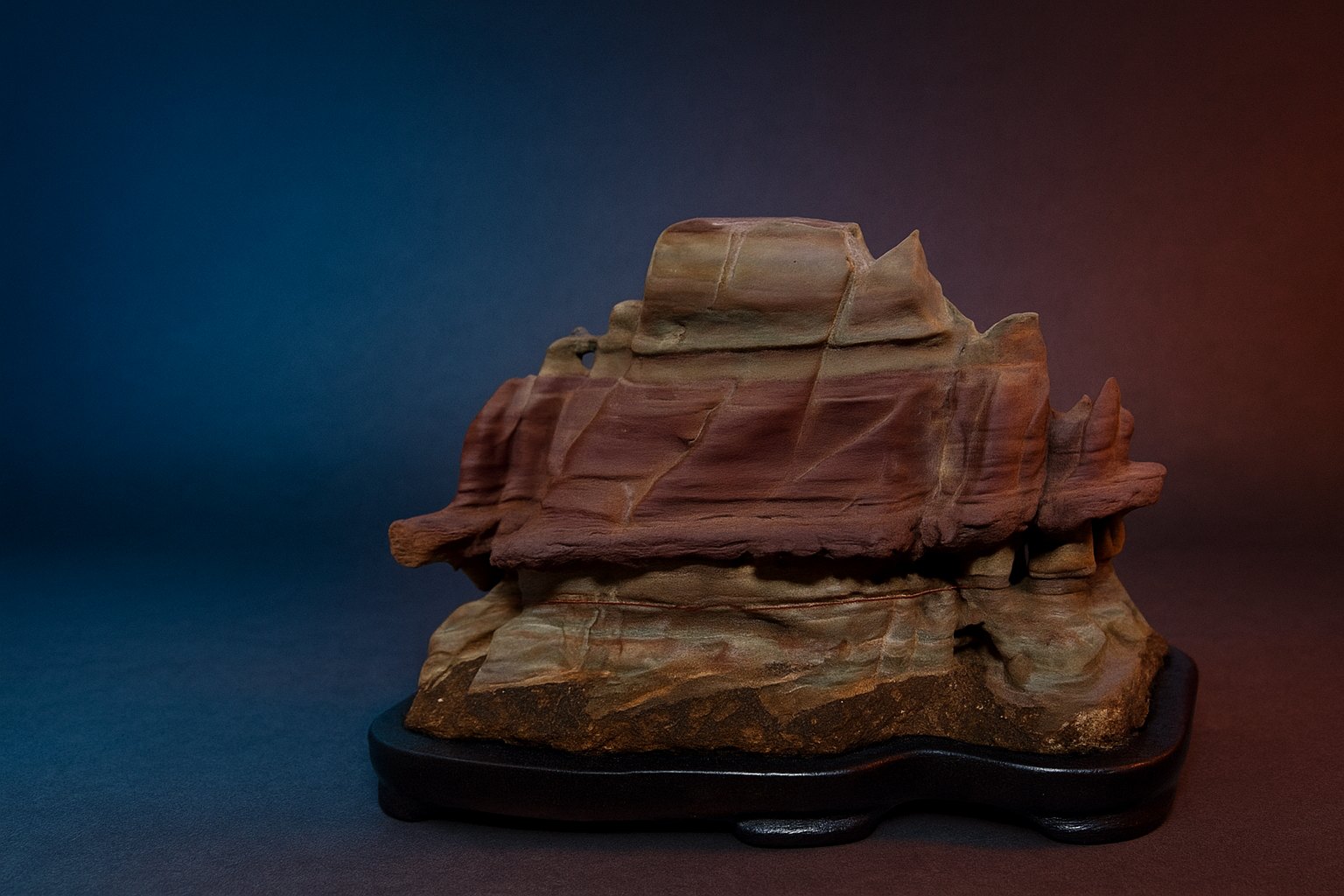
• Aka-seki (Red Stones): Ranging from terracotta red to deep crimson. Aesthetically associated with autumnal foliage (momiji), twilights, fire, or volcanic activity. Notable classical examples include Sajigawa aka-seki.
• Ao-seki / Seisei-seki (Blue or Greenish-Blue Stones): Spanning shades from muted teal to deep slate blue. These stones evoke bodies of water, distant mist-covered mountains, or dense mountain flora. The Kamogawa ao-seki from Kyoto represent a benchmark in this category.
• Midori-seki (Green Stones): Stones featuring moss-green, olive, or muted emerald tones. Their interpretive value is tied to forested slopes, valleys, or fields covered in spring vegetation.
• Ki-seki (Yellow or Ochre Stones): Covering spectrums from arid ochre to soft golden yellow. They suggest early morning light, deserts, harvested fields, or moonlight.
• Goshiki-seki (Five-Color or Polychrome Stones): Stones integrating multiple distinct colors within a single natural matrix. For high-tier appreciation, color transitions must appear organic rather than fragmented. Famous examples originate from the Kurama and Saji river systems.
Critical Evaluation Criteria for Color in Suiseki
A brightly colored stone does not automatically qualify as a high-grade suiseki. To evaluate aesthetic quality within Shikisei-seki, the following criteria must be critically applied:
• Saturation and Tone: Color must be natural, muted, and deep rather than artificially intense. Avoid gaudy, overly vibrant colors that resemble mineralogical specimens (ge) rather than landscape stones.
• Patina (Koshoku / Mochikomi): The surface must show maturity and aging, exhibiting a soft luster derived from time and handling (koshoku) accumulated through long-term care in a collection (mochikomi). This gradual process ultimately results in yoseki, the mature natural patina highly valued in suiseki appreciation. A glassy, harsh shine or unnatural lacquering obscures the raw stone texture and degrades its aesthetic value.
• Subordination to Form: Color must support and enhance the suggested landscape or object, never override it. Stones with striking color but flat, shapeless, or incoherent physical structures fail as suiseki.
• Contrast and Transition: In polychrome or veined stones, color boundaries must be balanced and seamless. Abrupt, unnatural breaks or chaotic patterns disrupt contemplative focus.
Classification by Surface Pattern
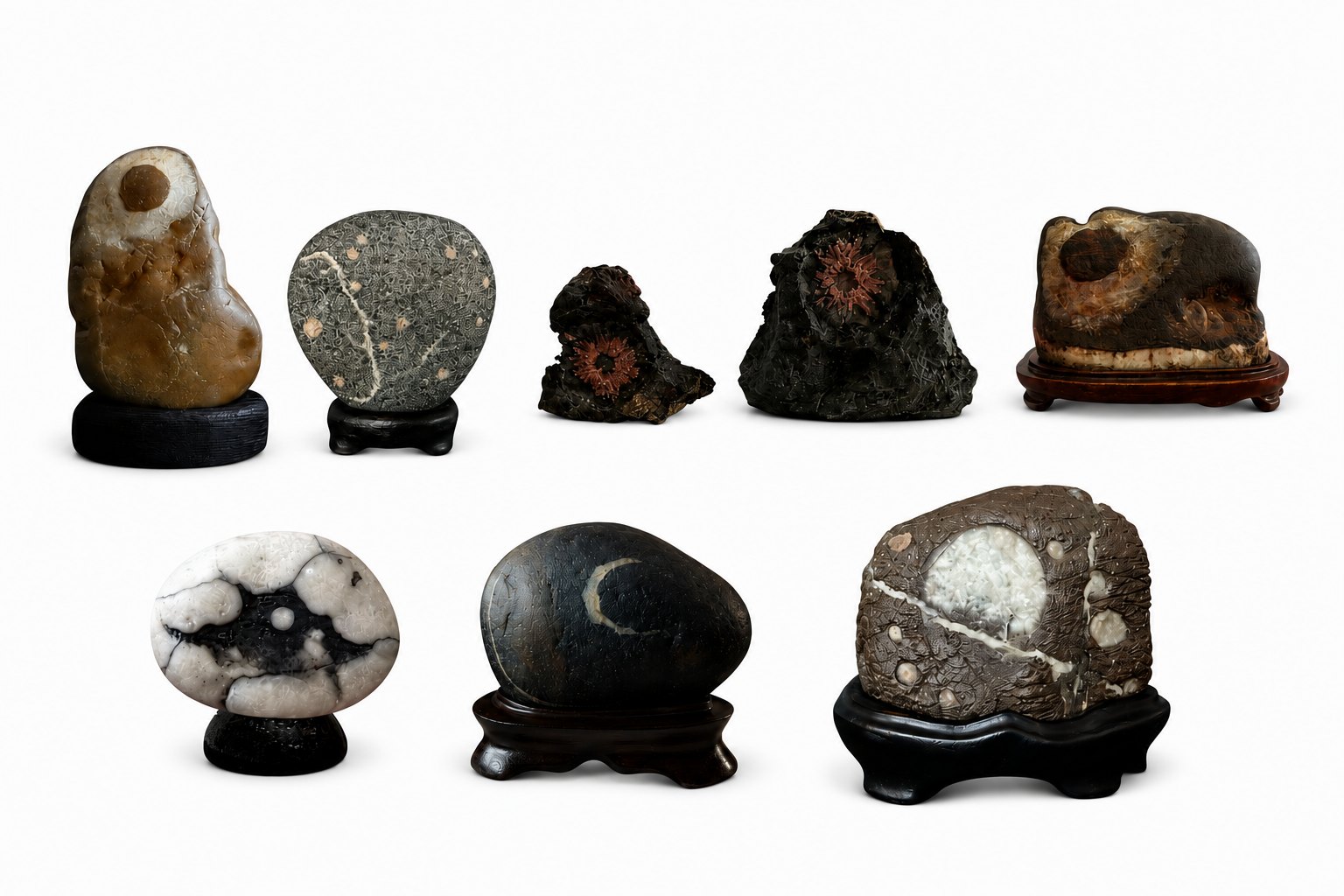
Some suiseki are appreciated not primarily for their shape, but for the distinctive patterns found on their surface. Known as Mon’yō-seki or Mon-seki (Pattern Stones), these stones are valued for the natural designs created by their textures, colors, mineral inclusions, veins, and other geological features. Traditionally, Japanese collectors have favored patterns that evoke forms and scenes found in nature.
The principal categories include:
• Kigata-ishi (Tree Pattern Stones): Stones whose surface patterns resemble a tree, a plant, or part of a plant.
• Mori-ishi (Forest Pattern Stones): Stones displaying patterns that suggest a group of trees or a forest.
• Bonsai-ishi (Bonsai Pattern Stones): Stones whose natural markings resemble a bonsai tree in its container.
• Hanagata-ishi (Flower Pattern Stones): Stones whose surface matrix reveals natural floral motifs formed through mineral crystallization. Among these, the following two types are especially admired in Japan:
◦ Kikka-seki (also known as Kikumon-seki or Kiku-ishi) (Chrysanthemum Stones): Renowned for natural mineral formations—typically celestite or quartz—that radiate outward to resemble the imperial chrysanthemum. These stones are highly prized by both Japanese and Western collectors, as the chrysanthemum traditionally symbolizes longevity and nobility in Eastern culture.
◦ Baikamon-seki (also known as Baimon-seki): Prized for rounded, scattered mineral deposits resembling the delicate five-petaled blossoms of the Japanese plum (ume).
Classification by Place of Origin
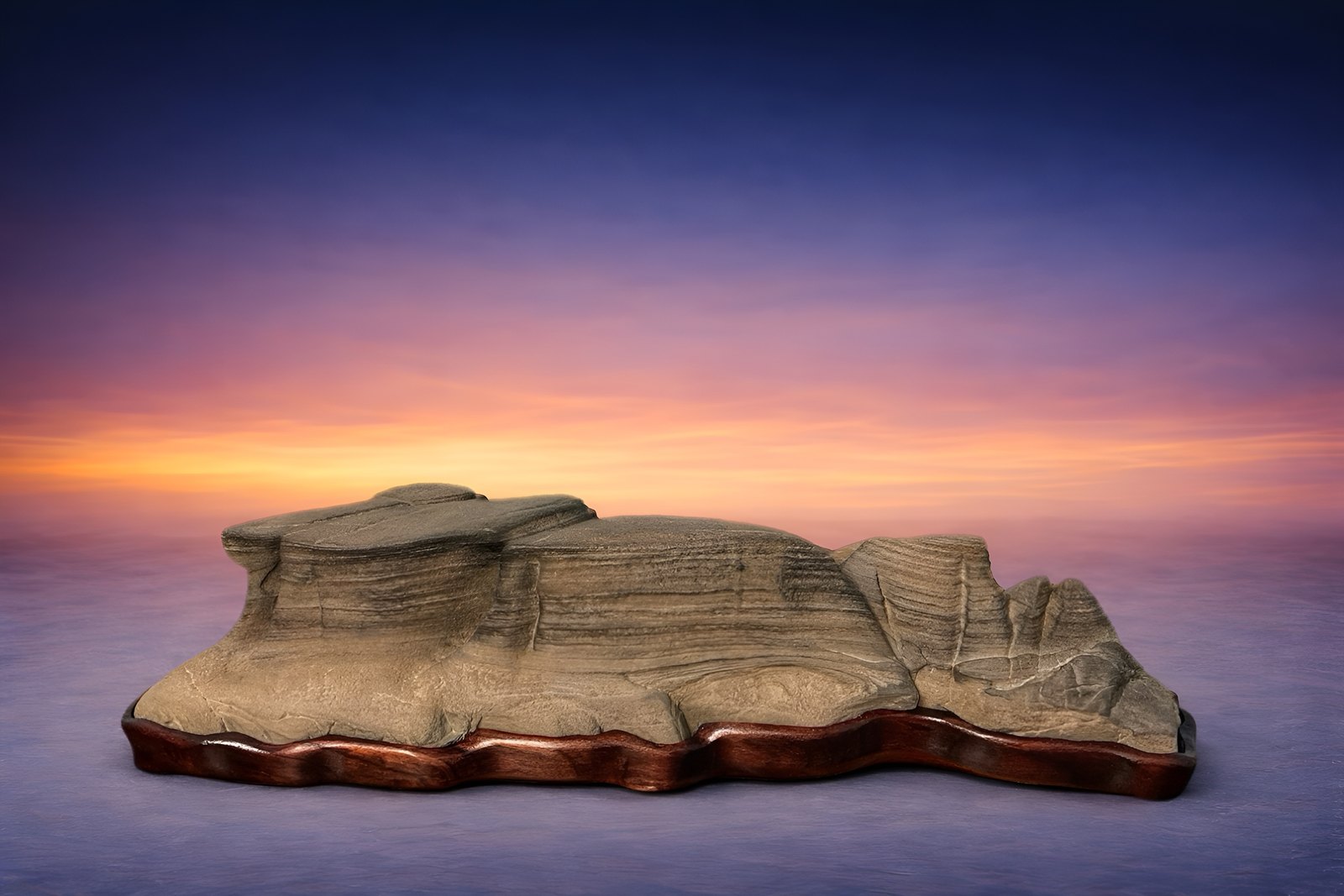
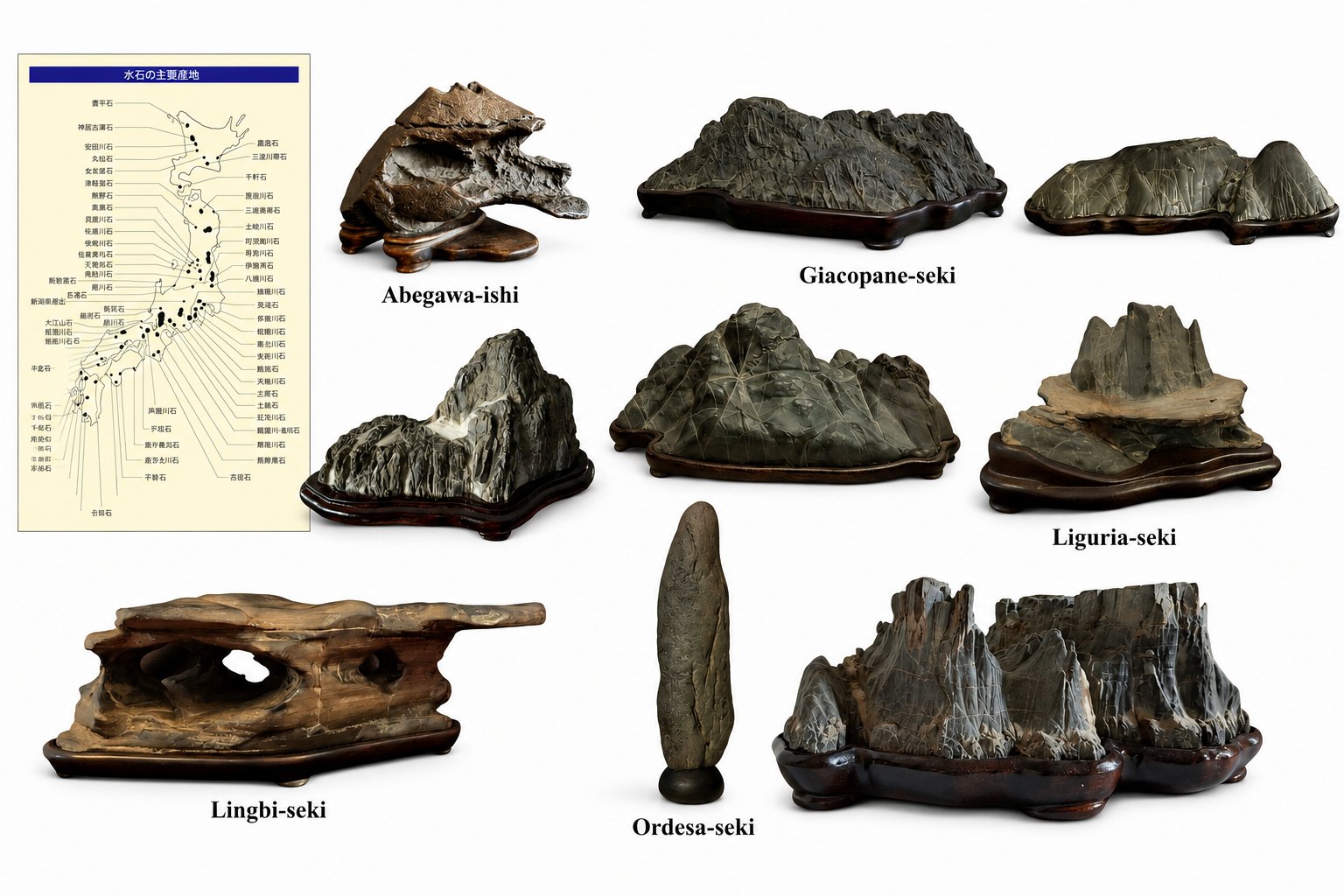
Almost all Japanese collectors, as well as a growing number of Western enthusiasts, classify suiseki according to their place of origin. In fact, some Japanese collectors and publications rely exclusively on this system of classification. In Japanese practice, this is done by combining the name of the river, mountain, or region where the stone was collected with the suffix -ishi or -seki. Well-known examples include Abegawa-ishi, Kamogawa-seki, Sajigawa-seki, Kurama-ishi, and Furuya-ishi.
Abegawa-ishi is included below as one such established example, from the Abe River in Shizuoka Prefecture. The remaining four names are not traditional Japanese terms: they are the author's own stones, collected in Italy, China, and Spain, named here by applying the traditional Japanese place-name convention, using the suffix -seki consistently for localities outside Japan.
For the non-Japanese localities presented in this article, the suffix -seki has been adopted consistently. Although both -ishi and -seki are valid readings of the Japanese character 石 ("stone"), the author considers -seki the more appropriate choice when referring to modern collecting localities outside Japan. This editorial decision is intended solely to provide terminological consistency throughout the article and should not be understood as proposing a new nomenclatural standard.
• Abegawa-ishi—Abe River, Shizuoka Prefecture, Japan. Renowned for mountain and waterfall stones, with characteristic veining from ferroaxinite, serpentine, and diopside.
• Lingbi-seki*—Lingbi County, Anhui Province, China. Traditionally counted among the Four Great Chinese Scholar's Stones and prized since the Song dynasty for its dense limestone and its resonant tone when struck.
• Liguria-seki*—Ligurian Alps, Italy, the wider region from which Giacopiane stones are collected. A hard limestone known locally as palombino, geologically comparable to Japan's Furuya-ishi, a celebrated limestone traditionally appreciated in suiseki.
• Giacopiane-seki*—Lago di Giacopiane, Borzonasca, Province of Genoa, Liguria, Italy. The largest and most celebrated palombino outcrop in Italy and an important destination for Italian suiseki enthusiasts.
• Ordesa-seki*—Ordesa y Monte Perdido National Park, Aragonese Pyrenees, Spain. An almost entirely limestone massif, shaped over millions of years by karstic dissolution and glacial erosion.
* Not an established term in traditional Japanese suiseki literature—see the note below.
Note on Provenance and Naming Conventions
Of the five names above, only Abegawa-ishi is an established term in Japanese suiseki literature. Lingbi-seki, Liguria-seki, Giacopiane-seki, and Ordesa-seki are not; they refer to Chinese, Italian, and Spanish localities and are used here solely to identify stones in the author's own collection by applying the traditional Japanese place-name convention.
Outside Japan, Western collectors have generally adopted a variety of naming practices for locally collected stones. The four non-Japanese names presented here do not propose a new classification system, nor are they intended to replace the terminology currently in use elsewhere. They simply demonstrate that the traditional Japanese convention can be applied consistently to collecting sites beyond Japan whenever provenance is used as a means of identification.
Naming Suiseki
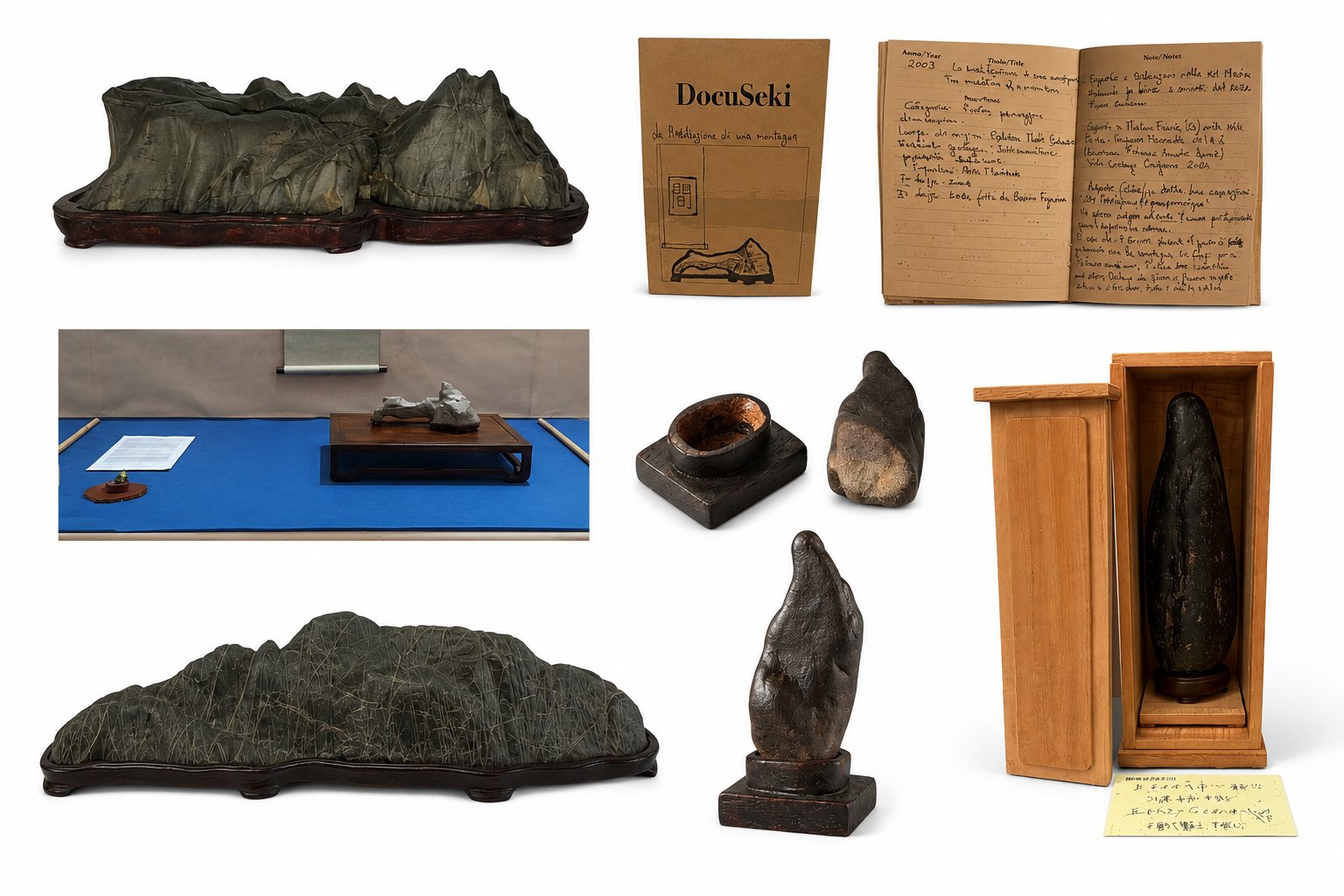
According to Covello and Yoshimura, most Japanese collectors identify their viewing stones using one or more of the classification systems described above, although it is uncommon to apply all four simultaneously. When more than one system is used, the order is traditionally as follows:
• Shape
• Color
• Surface Pattern
• Place of Origin
A poetic name is often added after the classification, giving the stone a more personal and evocative identity.
Both the suffixes -ishi and -seki mean “stone.” -Ishi is the older form and is more commonly associated with traditional or historic stones, whereas -seki is the more modern usage.
A special category is Yuraiseki (“historic stone”), referring to a historically significant suiseki or, more rarely, to a biseki—a naturally colored or traditionally polished viewing stone—that once belonged to an important historical figure or is associated with a notable historical event.
Having seen how a suiseki is classified and named, we turn now to its artistic dimension: the principles that govern how it is displayed.
Keidō and Kazari
The first and most important concept in understanding Kazari and Keidō is to recognize that, although both concern the display of bonsai and suiseki, they are not synonymous.
The Japanese word Kazari simply means “display” or “arrangement.” Used on its own, or in expressions such as Toko Kazari, it refers to the display of bonsai and suiseki in a tokonoma. The term Seki Kazari, on the other hand, describes the presentation of bonsai and suiseki on long exhibition tables, as commonly seen at exhibitions and conventions.
Keidō (景道), by contrast, literally means “the Way of Landscape.” It is a traditional Japanese art governed by a formal body of aesthetic principles and transmitted through the iemoto system within the Keidō Katayama-ryū. Beyond its literal meaning, its purpose is to delight and elevate the human spirit through the harmonious display of natural beauty.
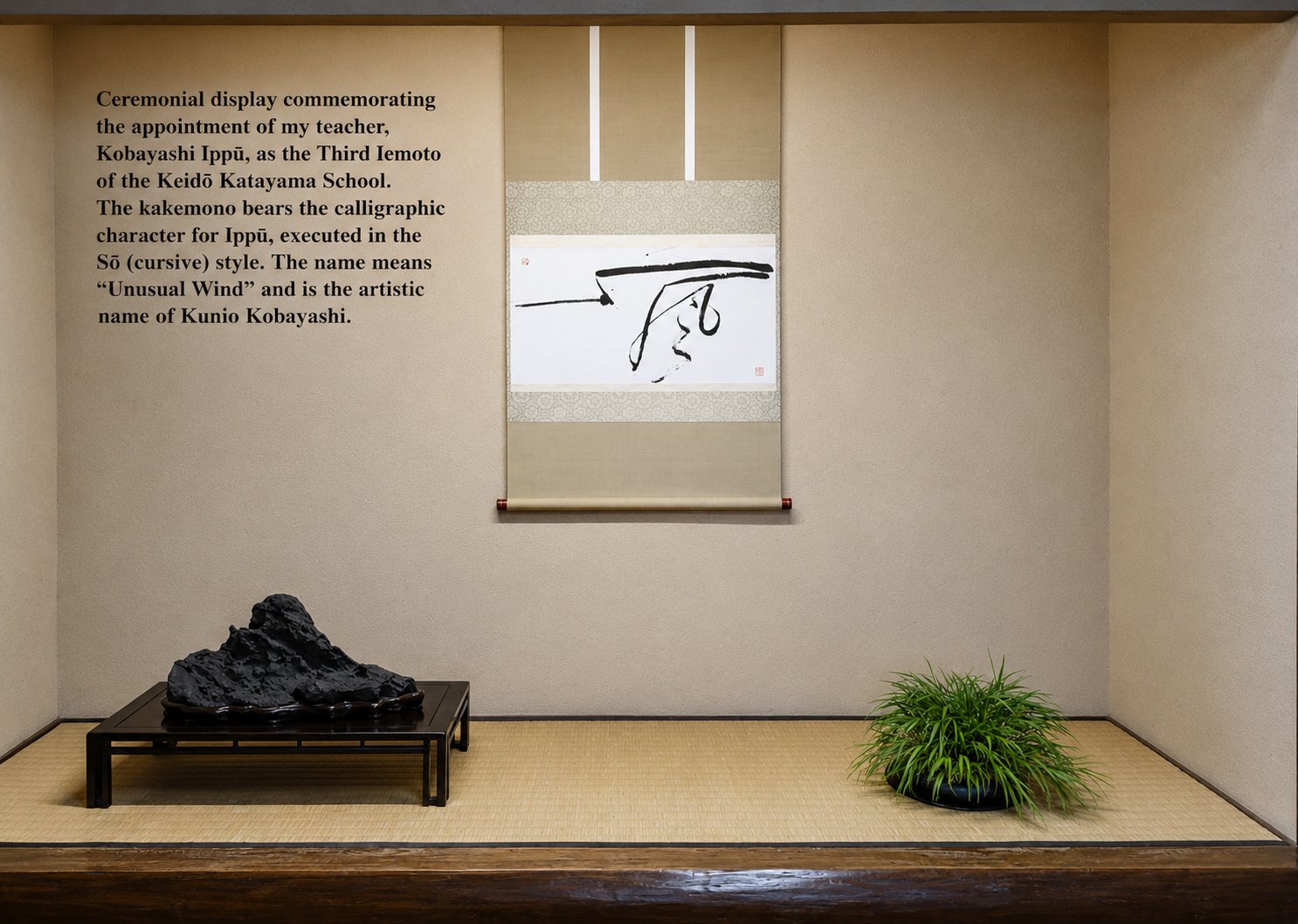
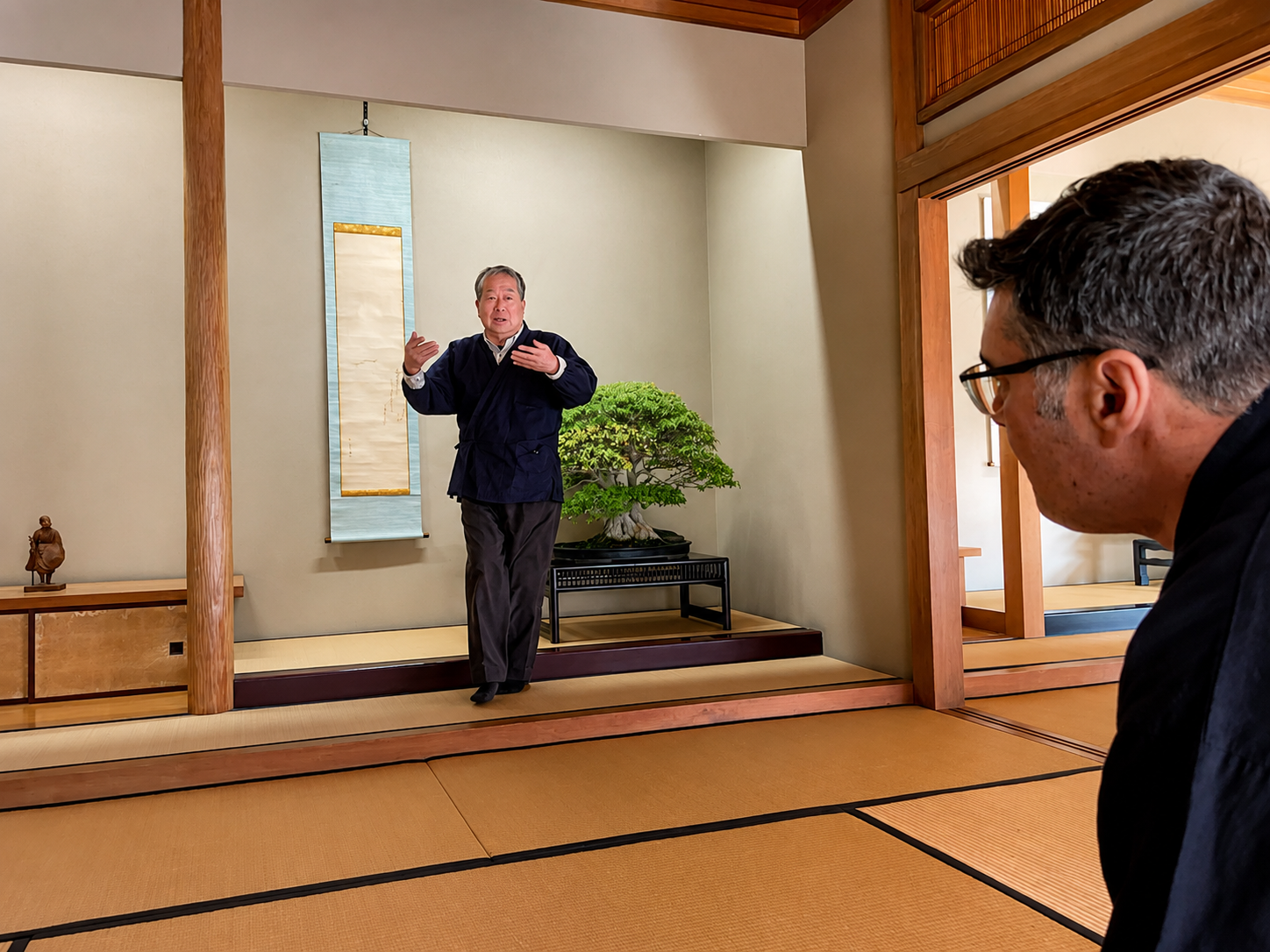
After many years of study and analysis, the Japanese master Katayama Ichiu founded the Keidō Katayama-ryū school in 1986, systematizing the principles of bonsai and suiseki display. To support this teaching, he wrote the Keidō Katayama-ryū manual, a three-volume work that remains part of the curriculum taught at his prestigious school, now known as Keimeikai, of which I am a member. Upon Katayama Ichiu’s death, the school passed to his disciple Sudo Uhaku as 2nd Iemoto; upon Sudo Uhaku’s retirement, it passed to my own master, Kobayashi Kunio (Ippū)—also a direct disciple of Katayama Ichiu—as 3rd Iemoto.
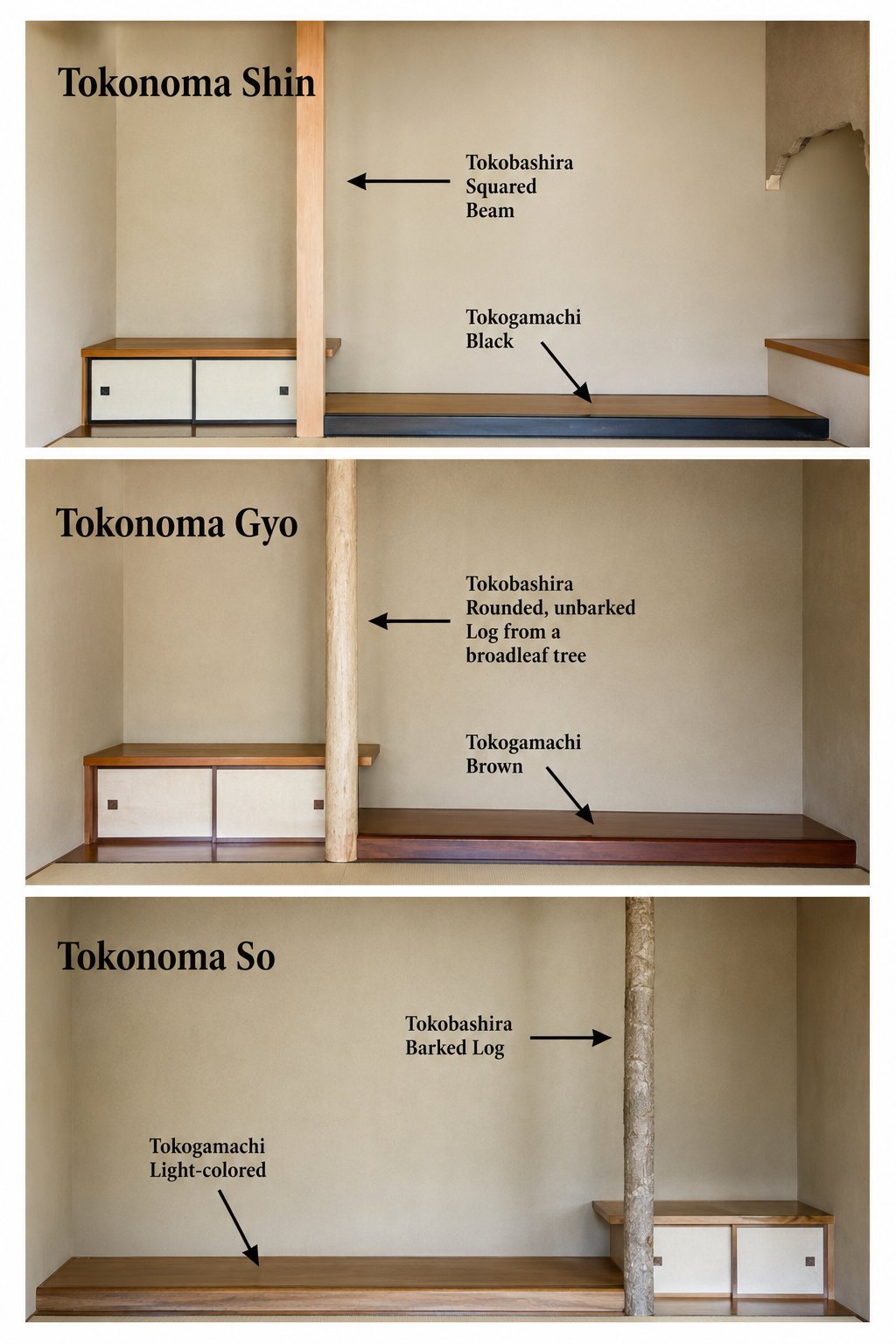
The tokonoma is a recessed alcove found in the principal room of a traditional Japanese house. It is intended for the display of beautiful objects during special occasions such as the New Year, festivals, and weddings. Considered a sacred space and raised above floor level, the tokonoma first appeared during the Muromachi period (14th–16th centuries). It is traditionally used to display bonsai, suiseki, ikebana, and other artistic elements that together represent the cosmic trilogy of heaven, humanity, and earth. Like the rest of the room, its floor is covered with tatami, although it is generally elevated.
Understanding a Kazari
A kazari is not simply a collection of objects placed together for decoration. In the Japanese tradition, it is a carefully composed arrangement in which each element has a specific role and contributes to the expression of a single unified idea. Every component is selected and positioned to create harmony, balance, and a subtle emotional response rather than to attract attention individually.
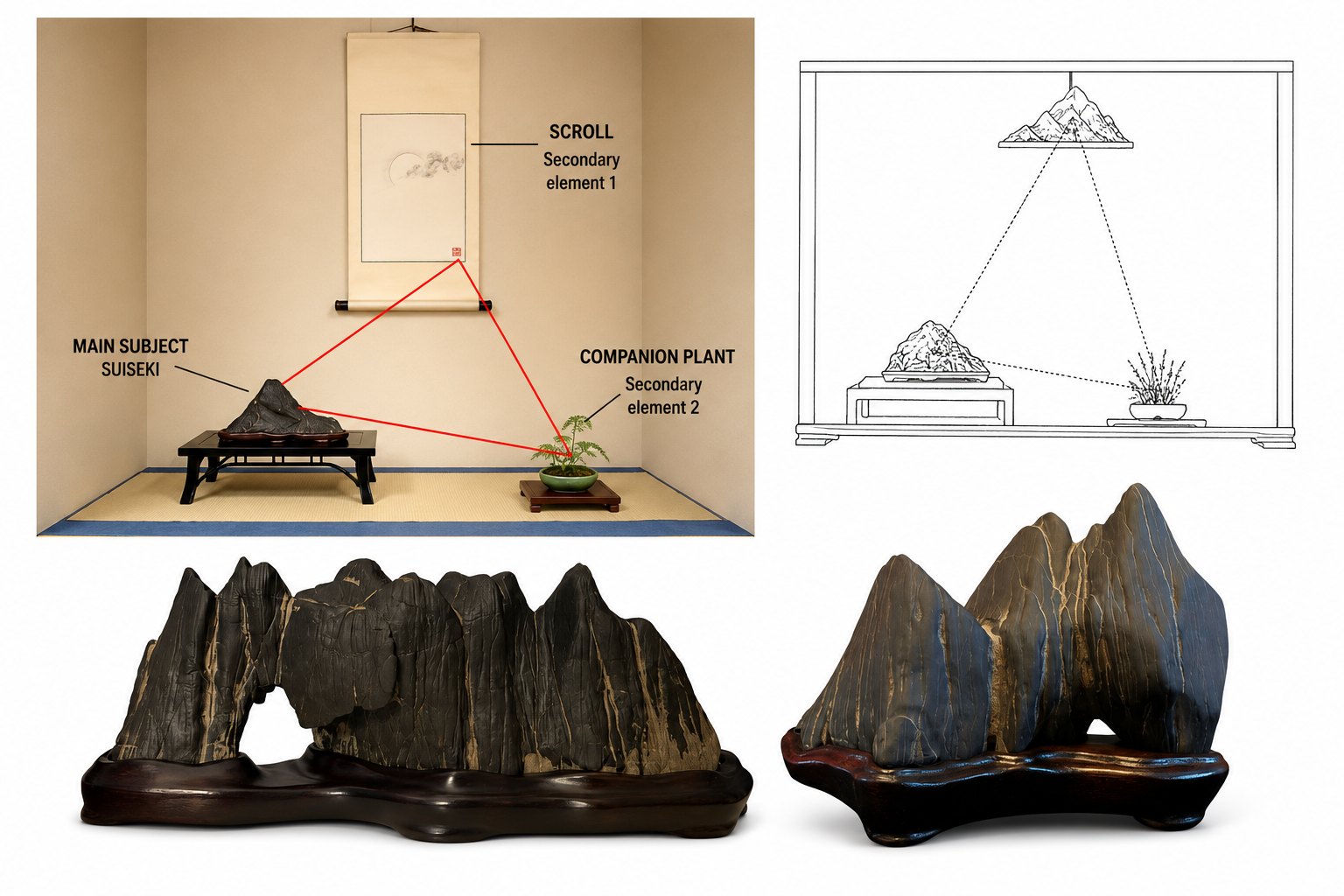
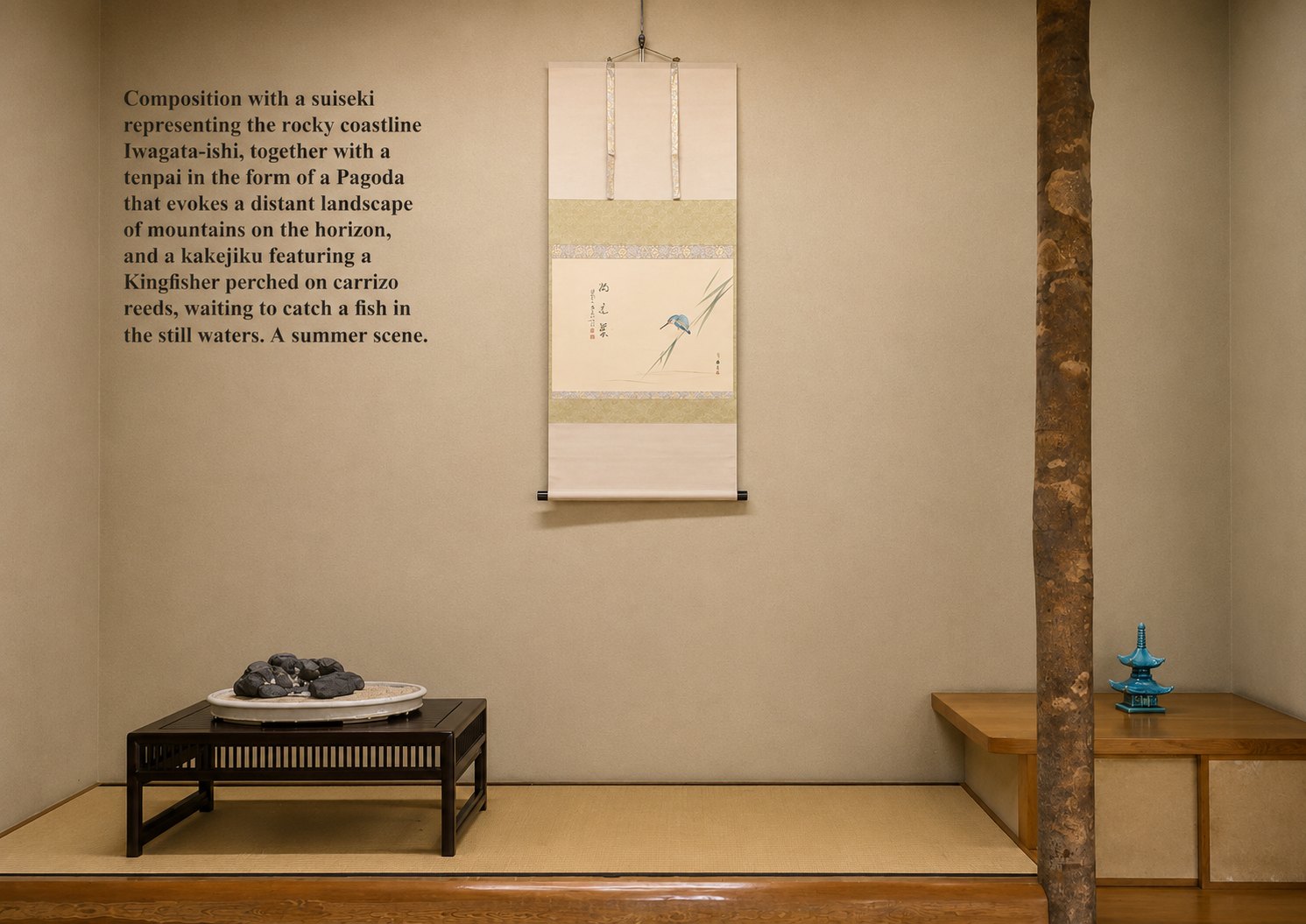
A traditional kazari is built around a principal element—such as a suiseki or a bonsai—which establishes the main subject of the display. Supporting elements, including a hanging scroll (kakejiku) and an accent plant (shitakusa; a kusamono may also be used, although it is generally a larger planting that can be displayed as a principal element in its own right), are chosen to complement the principal object without competing with it. Together, they suggest a season, a place, or an atmosphere, inviting the viewer to complete the landscape through imagination.
Equally important is the space between the elements. In Japanese aesthetics, empty space is never considered unused space; it is an active part of the composition that creates rhythm, balance, and visual breathing room. The relationship between objects, rather than the objects themselves, gives life to the display.
Within the Keidō tradition, the creation of a kazari follows established aesthetic principles that govern proportion, placement, visual balance, seasonal appropriateness, and the harmony between all elements. These principles transform a simple display into an artistic expression that seeks to convey the beauty of nature with refinement, restraint, and respect for tradition.
The following sections examine each element of a kazari individually, explaining not only its function but also its contribution to the harmony of the complete composition according to the principles of Keidō.
Stone Direction
One of the most important principles in suiseki display is establishing the direction of the stone. Every viewing stone has a natural visual movement that should be identified and respected throughout the composition. The stone should never appear to “leave” the display but should instead direct the viewer’s eye naturally toward the remaining elements.
When arranging a composition, the visual centers of gravity of the three principal elements should be connected by imaginary lines, forming an asymmetrical scalene triangle. This relationship creates visual balance while preserving the natural asymmetry that is fundamental to Japanese aesthetics. A symmetrical arrangement should always be avoided, as it weakens the composition and diminishes its sense of harmony and movement.
The Character of a Suiseki
Every suiseki possesses its own character, an intrinsic quality that resides in the stone itself—independent of any table, scroll, or companion element—and that should be identified before any display is even considered. In the Keidō tradition, this character is read through the stone’s silhouette, mass, and surface, and classified into three aesthetic categories shared by Japanese traditional arts:
• Shin (Formal): A strong, dignified, and majestic character, expressed through solid mass, firm lines, and an imposing, self-assured presence. Stones in this category convey stability and authority, and demand a display of equal formality.
• Gyō (Semi-formal): A balanced and harmonious character that tempers elegance with natural softness—neither as austere as Shin nor as loose as Sō. It is the most adaptable character, at ease in both formal and relaxed settings.
• Sō (Informal): A free, spontaneous, and irregular character, expressed through broken lines, rough texture, or an asymmetrical silhouette. These stones evoke naturalness and movement, embracing imperfection as beauty.
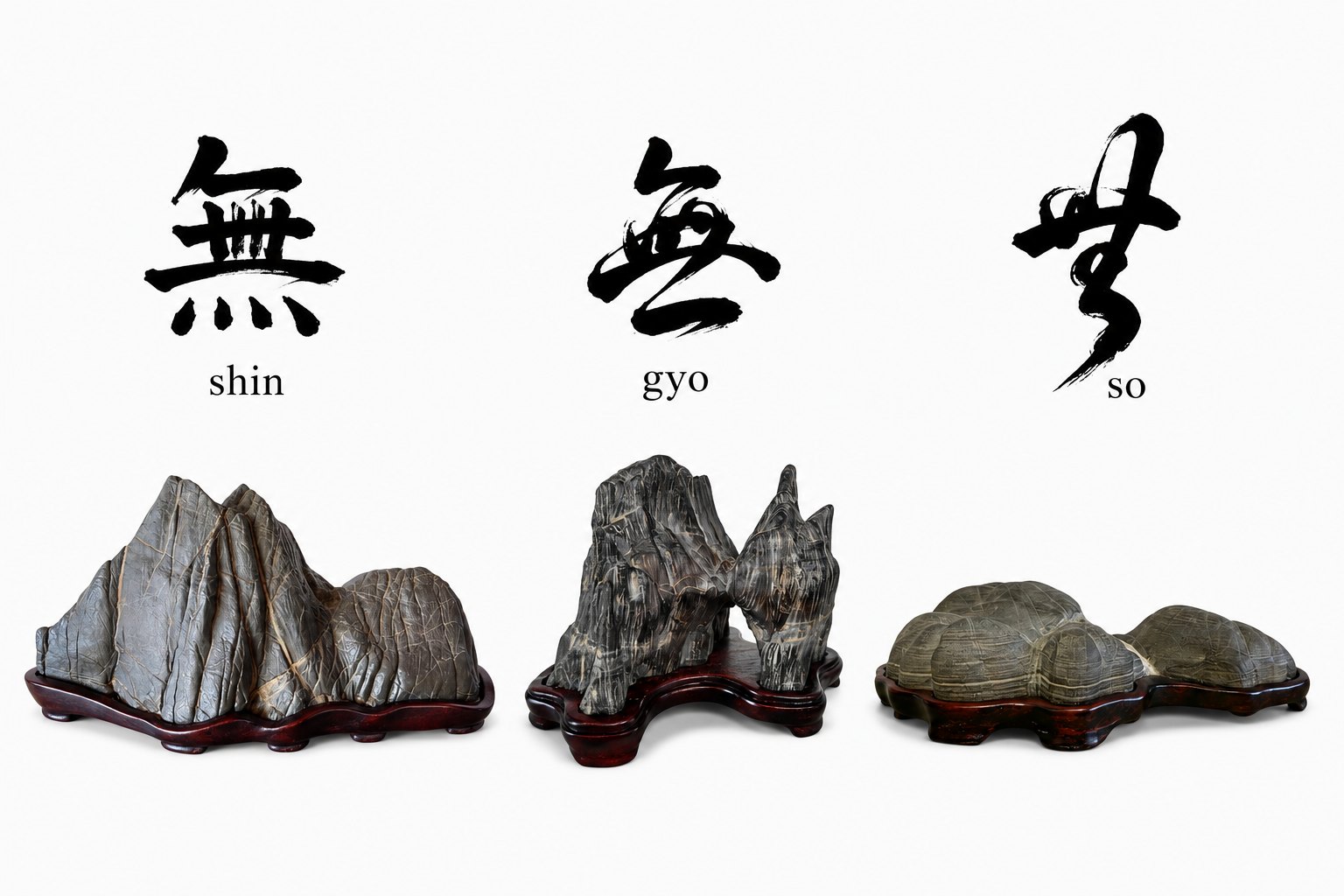
This same tripartite framework—Shin, Gyō, Sō—governs not only the stone but the composition as a whole. Once the character of the suiseki has been established, every element added around it (table, scroll, companion pieces) must be chosen in that same register, so that the finished display speaks with a single voice rather than working against the stone it presents.
• Shin (Formal): A composition of formal balance and ceremonial dignity, reserved for the most solemn occasions—ideal counterpart to a Shin stone’s authority.
• Gyō (Semi-formal): The most versatile register, pairing refinement with a more relaxed arrangement—the natural home for a Gyō stone, though flexible enough to soften a Shin stone or lend structure to a Sō one.
• Sō (Informal): A free, unforced arrangement that lets asymmetry and natural irregularity lead—the fitting stage for a Sō stone’s spontaneity.
Although Shin favors order, no register should ever tip into bilateral symmetry: as throughout Japanese display, balance is always asymmetrical. What ultimately fails a composition is not the register chosen, but a mismatch between it and the character of the stone it surrounds.
Display Tables (Shoku)
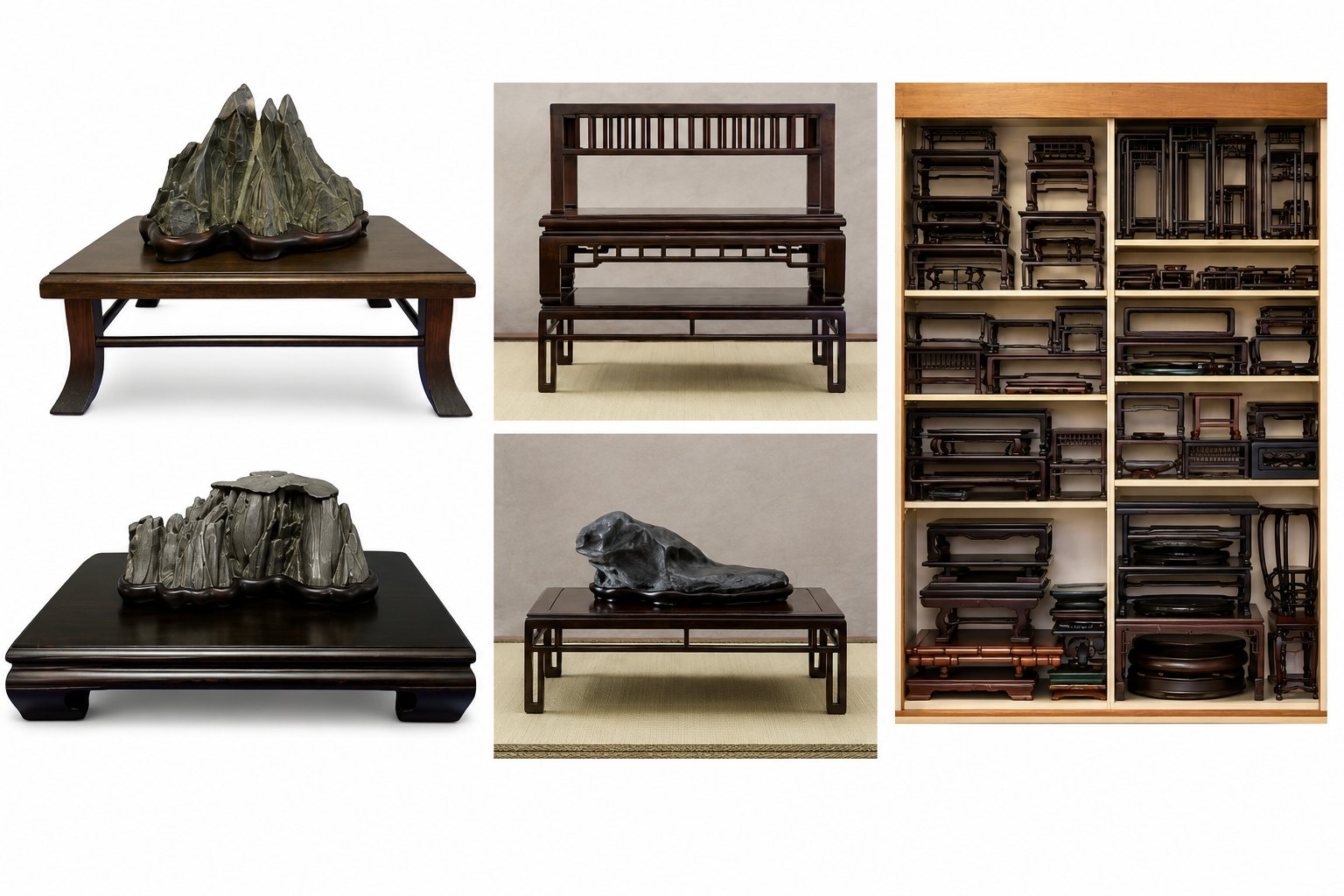
In suiseki display, tables are generally lower and proportionally larger than those used for bonsai, creating a stronger impression of a natural landscape. Choosing the appropriate table is often one of the most challenging aspects of a composition, as it must complement the style and character of the stone, achieving balance and harmony without competing for attention.
Dark-toned tables are generally preferred because they do not distract the viewer or create excessive contrast with the viewing stone, which is usually dark in color. Ideally, a collector should have several tables available in order to select the most suitable one for each composition. Although this is not always possible, every effort should be made to find the most appropriate table, as it can ultimately determine the success or failure of the display. If the ideal table is unavailable, borrowing one is a common practice—in Japan, display tables can even be rented.
Simple, elegant tables made from fine dark woods are usually the best choice. The stone should be positioned comfortably within the recessed panel of the tabletop, maintaining equal spacing on all sides and taking care not to scratch the surface. Many tables display a visible wood grain that establishes a natural direction, which should be respected so that it harmonizes with the movement of the other elements in the composition. Finally, the table must be correctly proportioned so that neither the stone nor the table appears visually dominant or insignificant.
This relationship broadly follows the Shin, Gyō, and Sō aesthetic framework introduced earlier, with more formal stones paired with stronger, more structured tables, and more informal stones with lighter, more natural designs.
Hanging Scrolls (Kakejiku)
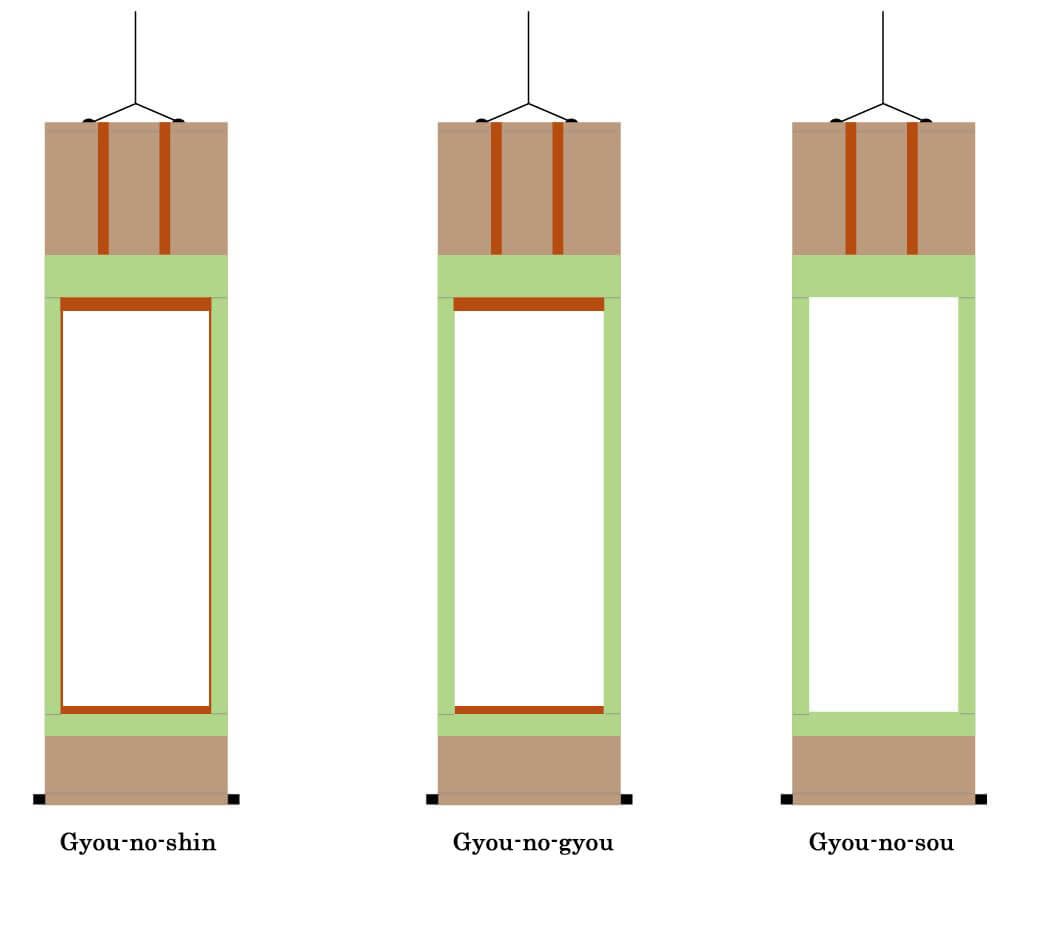
The next element that may appear in a tokonoma display is the kakejiku. Like the viewing stone, the scroll has its own direction or visual flow. It acts as a visual boundary for the composition, defining its movement and creating a space that enhances the overall presentation. The artist’s signature, often placed near the bottom of the scroll, is commonly used as the point at which this visual movement comes to rest.
The scroll should always be in harmony with the season the composition is intended to evoke. A spring display should include imagery appropriate to spring, while a winter composition should reflect the atmosphere of that season. The subject of the scroll should also correspond to the style of the stone and the landscape it represents. A stone suggesting a mountain, for example, should be accompanied by elements associated with mountainous environments. The objective is to recreate a convincing scene in which every component—the suiseki and its companion elements—works together in harmony.
Calligraphy may be used when it reinforces the season or the mood of the display. Because its meaning is not always obvious, it is advisable to have the inscription translated to ensure it is appropriate. Another excellent option is a sumi-e painting. The subject should remain simple: a bird, a waterfall, the sun, the moon, clouds, or any other motif that naturally suggests a particular season or atmosphere.
Accent Plants (Shitakusa) & Tenkei Figurines
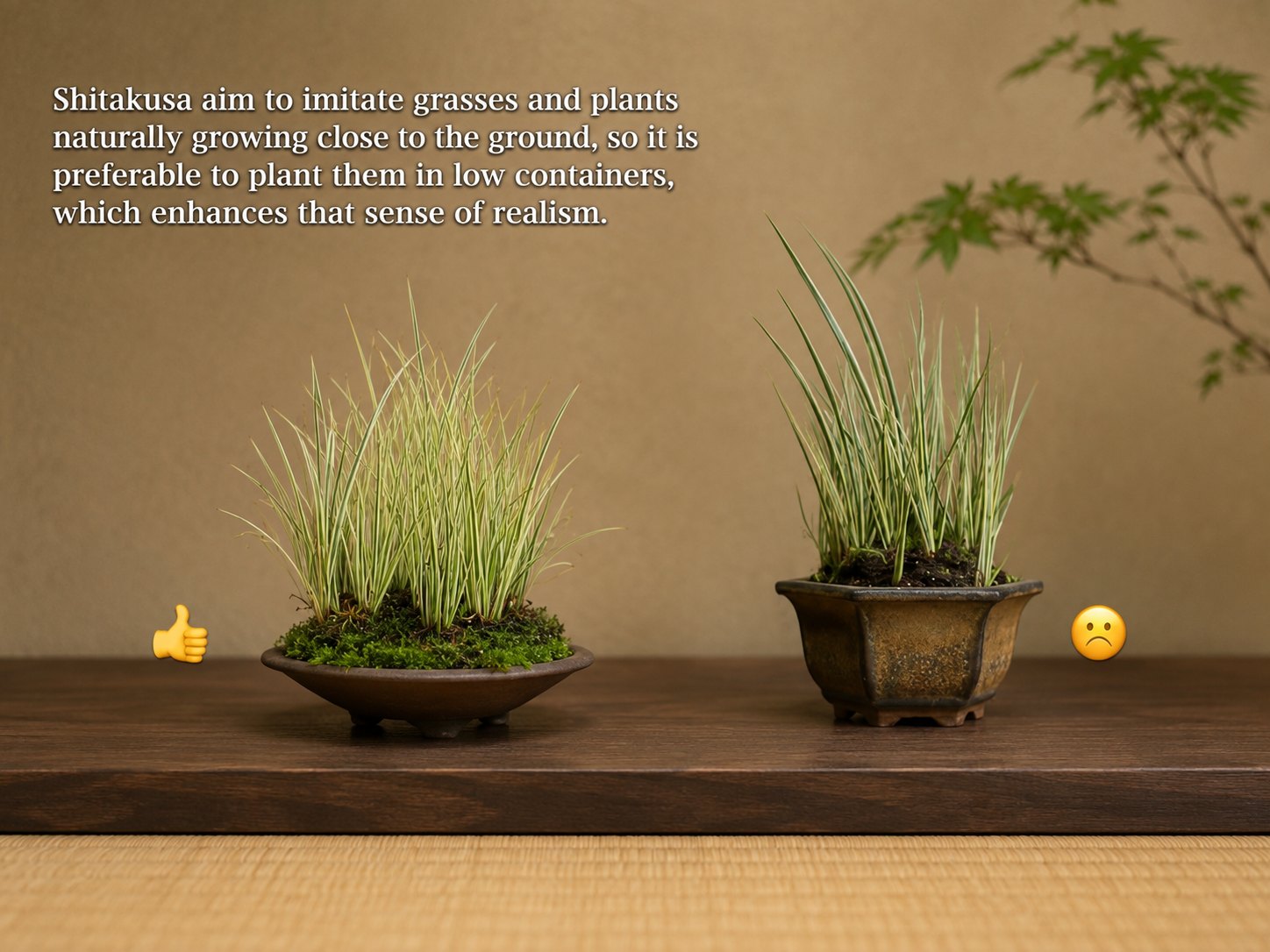
Adding an accent plant (shitakusa) to a composition serves to emphasize a particular characteristic of the viewing stone while creating a greater sense of harmony. Like the stone itself, a shitakusa usually has a natural direction that should be recognized and respected. It is traditionally positioned facing the stone, as if greeting it and continuing its visual movement.
An accent plant should be attractive in its own right, but never so striking that it becomes the dominant element of the display. Its role is to support the suiseki, which must always remain the principal focus of the composition.
The shitakusa should display a certain degree of maturity, and its container should never dominate the arrangement. In Japan, well-developed accent plants often grow to cover almost the entire pot after many years of cultivation. Pots with unusual shapes or bright colors should be avoided, as they attract unnecessary attention and weaken the impression of a natural habitat that the composition seeks to evoke.
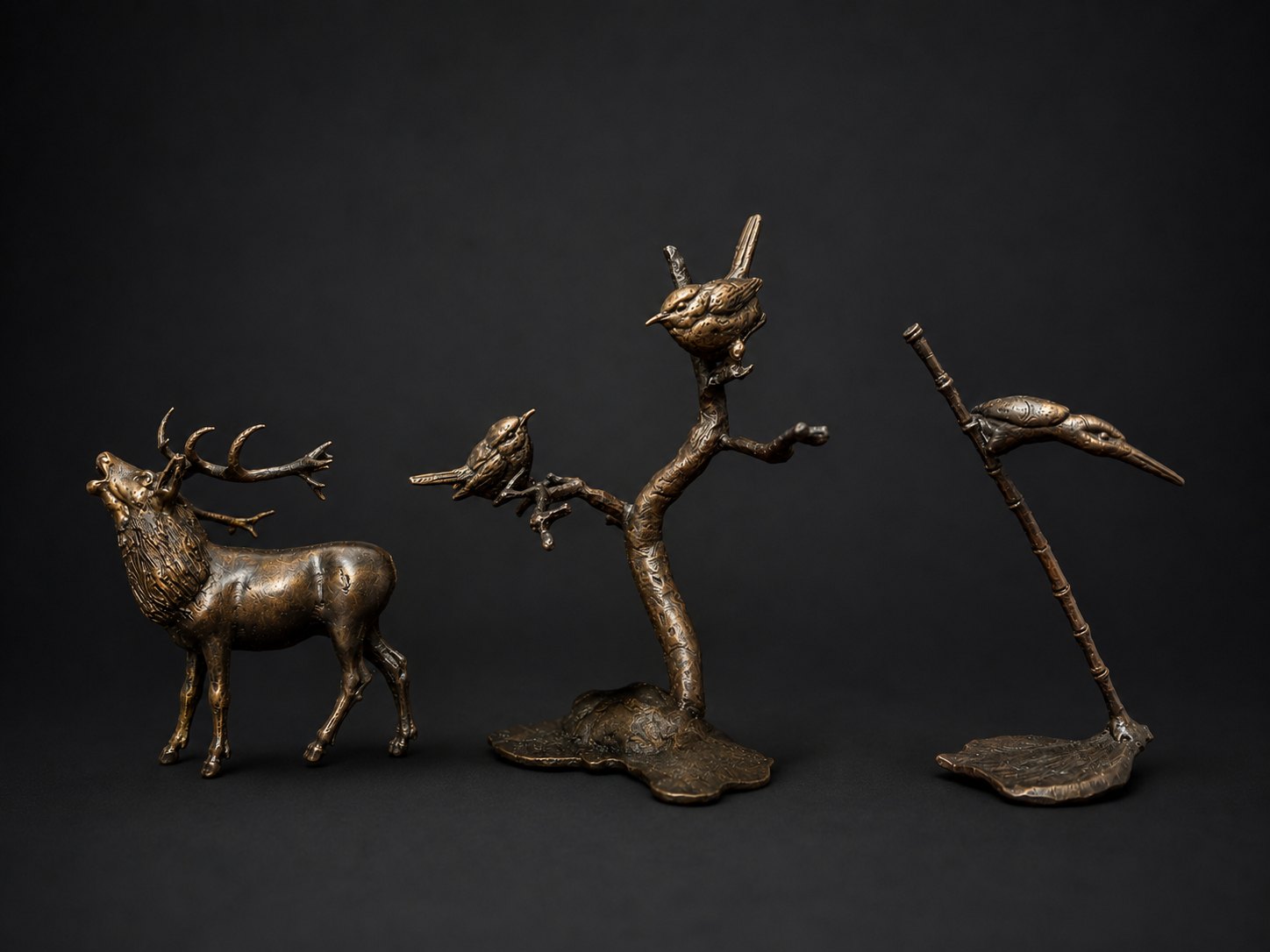
In addition to shitakusa, other accompanying elements may also be incorporated into a display, most notably tenkei, also known as tenpai. These accent figures serve a similar purpose to accent plantings: they help complete the narrative of the composition, reinforce its seasonal character, or evoke the landscape, atmosphere, or natural setting suggested by the suiseki. Traditionally, they are finely crafted from noble materials such as bronze, copper, wood, or ceramic. Whatever their form, they should remain discreet and understated, enhancing the composition without ever competing with the suiseki for the viewer's attention.
Displaying Suiseki
The art of suiseki is an art of contemplation, traditionally appreciated within a tokonoma or any carefully prepared display setting. A suiseki may be displayed on a custom-carved wooden base known as a daiza, or on a tray containing sand or water, known as a suiban when made of ceramic, or a doban when made of metal, usually bronze or copper. Selecting the appropriate support is fundamental, as it can either enhance or diminish the beauty and expressive power of the viewing stone.
The choice between a tray and a daiza is never arbitrary—it follows directly from what the stone represents. Island stones, coastal stones, waterfalls, and other landscape stones (Sansui Kei-seki) are traditionally displayed in a suiban or doban, where water or sand extends the stone’s own form into an implied horizon, reinforcing the illusion of an open natural scene that the stone alone could not fully suggest. Water was, historically, the first medium used for this purpose; sand was adopted only later as an alternative. By contrast, stones representing people, animals, houses, or other discrete objects—especially Sugata-ishi (human figure stones) and Kuzuya-ishi (thatched cottage stones)—are generally displayed on a daiza, since these subjects are not landscapes to be set within a wider natural setting, but self-contained forms whose presence is better framed and elevated by a carved wooden base than dissolved into sand or water. An accepted exception is the Funagata-ishi (boat stone), provided it clearly suggests an old boat; landscape stones, for their part, may always be displayed on a daiza as well, even though the tray remains their traditional setting.
Furuya-ishi, a type of traditional Japanese limestone, are a notable exception among landscape stones themselves: despite suggesting a natural scene, they are never displayed in a suiban or doban, nor with water or sand. The reason is material rather than aesthetic—their base is composed of a soft, highly moisture-sensitive rock that can disintegrate on prolonged contact with water. For this reason they are, and have always been, presented exclusively on a wooden daiza. Their reverence also carries a well-known legend: according to tradition, samurai would search a battlefield after losing a companion for a stone whose form recalled that place, keeping it afterward both as a memorial and as a token of having survived. Whether or not every detail can be historically verified, it speaks to the personal, commemorative dimension long attached to suiseki collecting in Japan—offered here as a curiosity, not as the reason for the daiza tradition itself. Stones traditionally displayed on carved wooden pedestals in the Chinese style are, for similar material reasons, generally stones whose composition would otherwise deteriorate through prolonged contact with water.
Both the daiza and the suiban should enhance the natural beauty of the suiseki without drawing attention away from it. Suiban are usually finished in neutral colors, such as cream or gray, while daiza are traditionally made in dark tones with natural finishes or transparent lacquer. Both supports should be as refined and unobtrusive as possible: the daiza finely carved, the suiban with a delicate profile, short feet, and only the minimum number of supports necessary. In every case, the simpler and more discreet the tray or daiza, the more successful the display will be, and the easier it will be for the viewer to appreciate the suiseki itself.
Traditional authors such as Vincent T. Covello and Yuji Yoshimura also recommend adapting the display to the season: during summer, a suiban with water or sand evokes freshness and coolness, while in winter a wooden daiza creates a warmer visual impression, reinforcing the seasonal atmosphere of the composition.
Today, many Japanese suiseki purists consider the tray to be the most authentic method of display, as it is directly connected to the earliest presentation of viewing stones during the Japanese tea ceremony, to the aesthetics of dry landscape gardens (karesansui), and to the Eastern philosophical concept of Yin and Yang (In-Yō in Japan). In a display using water, the water represents Yin—the feminine, moisture, mystery, softness, cold, darkness, and the north—while the stone represents Yang—the masculine, dryness, strength, warmth, light, and the south. Japanese collectors also value stones displayed in trays only when they have developed sufficient yoseki, the mature natural patina acquired through age and long-term care (koshoku and mochikomi): in Japan, the older the stone and the finer its patina—an expression of wabi-sabi—the more highly it is appreciated.
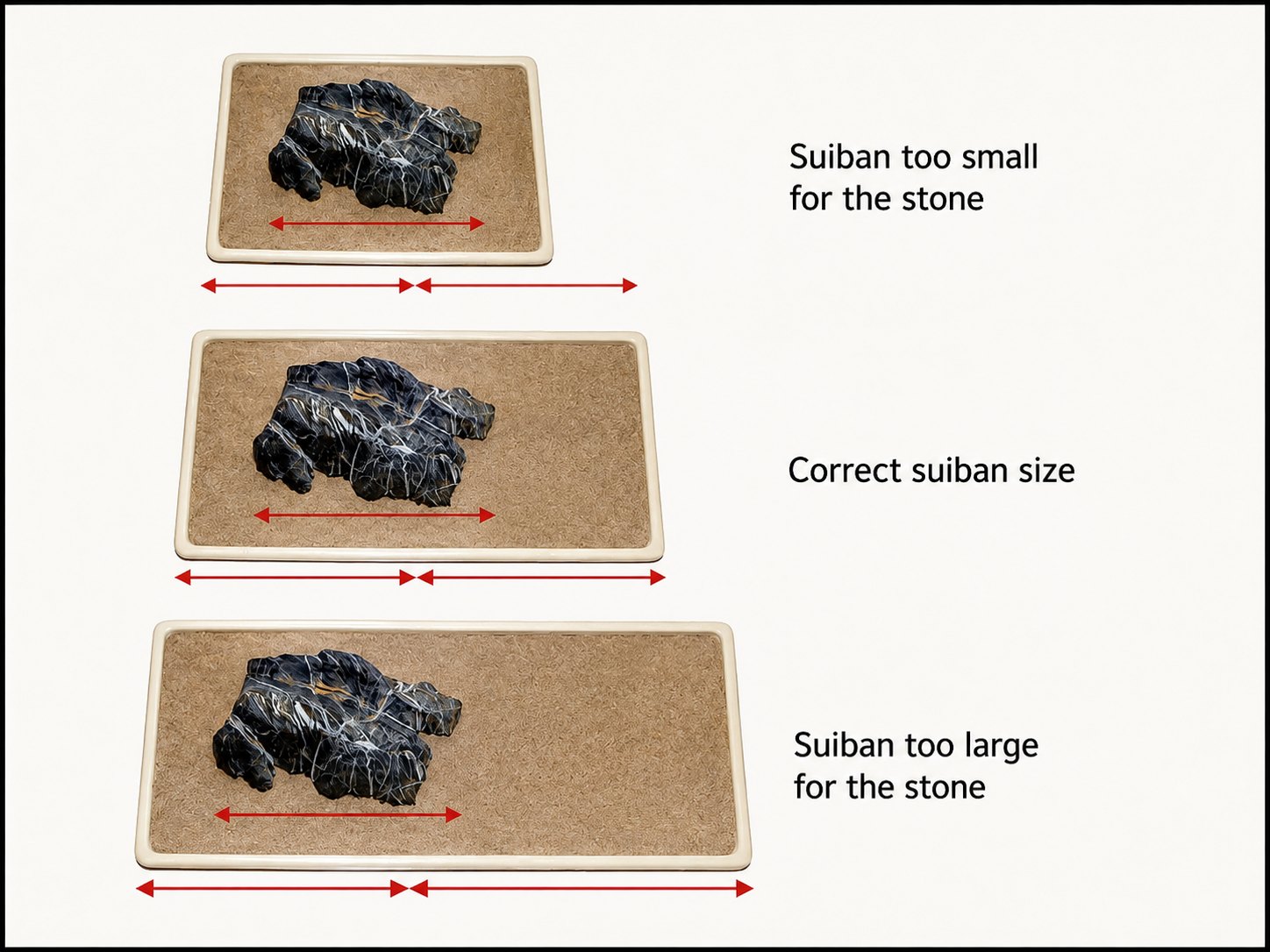
Choosing the Right Tray Size
The ideal proportion between the length of the tray and the length of the stone is approximately 2:1. When the tray is correctly sized—about twice the length of the viewing stone—it creates the generous sense of empty space surrounding the stone, a fundamental principle in suiseki display, as well as in bonsai, ikebana, and other Japanese arts. This feeling of space cannot be achieved by using a daiza alone.
The relationship between the height of the stone and the tray is equally important. A large, heavy, tall, sharply contoured, or visually powerful stone requires a tray with greater presence—slightly deeper, with stronger profiles, perhaps rectangular in shape, broader rims, more prominent feet, or subtle decorative details.
In contrast, a delicate, elegant, small, or softly contoured stone is best displayed in the simplest possible tray: shallow, with discreet sides, little or no rim, almost imperceptible feet, and preferably an oval shape.
As with display tables, the choice of tray should also reflect the stone’s Shin, Gyō, or Sō character, reinforcing the overall harmony of the composition.
Whenever there is any doubt, the simplest tray should always be chosen. The viewing stone must remain the most important element of the composition.
This 2:1 proportion is documented in the classical suiseki literature, notably in the work of Vincent T. Covello and Yuji Yoshimura; those who have not consulted their book, however, are far more likely to have encountered the principle in practice through the photographic documentation and courses of Master José Manuel Blázquez, of the Zen Bonsaikido School of Arts, to whom I express my sincere gratitude for having brought it to wider attention among practitioners.
Display Theme (Shudai)
When creating a suiseki composition, there are four principal approaches, depending on what inspires or motivates the display:
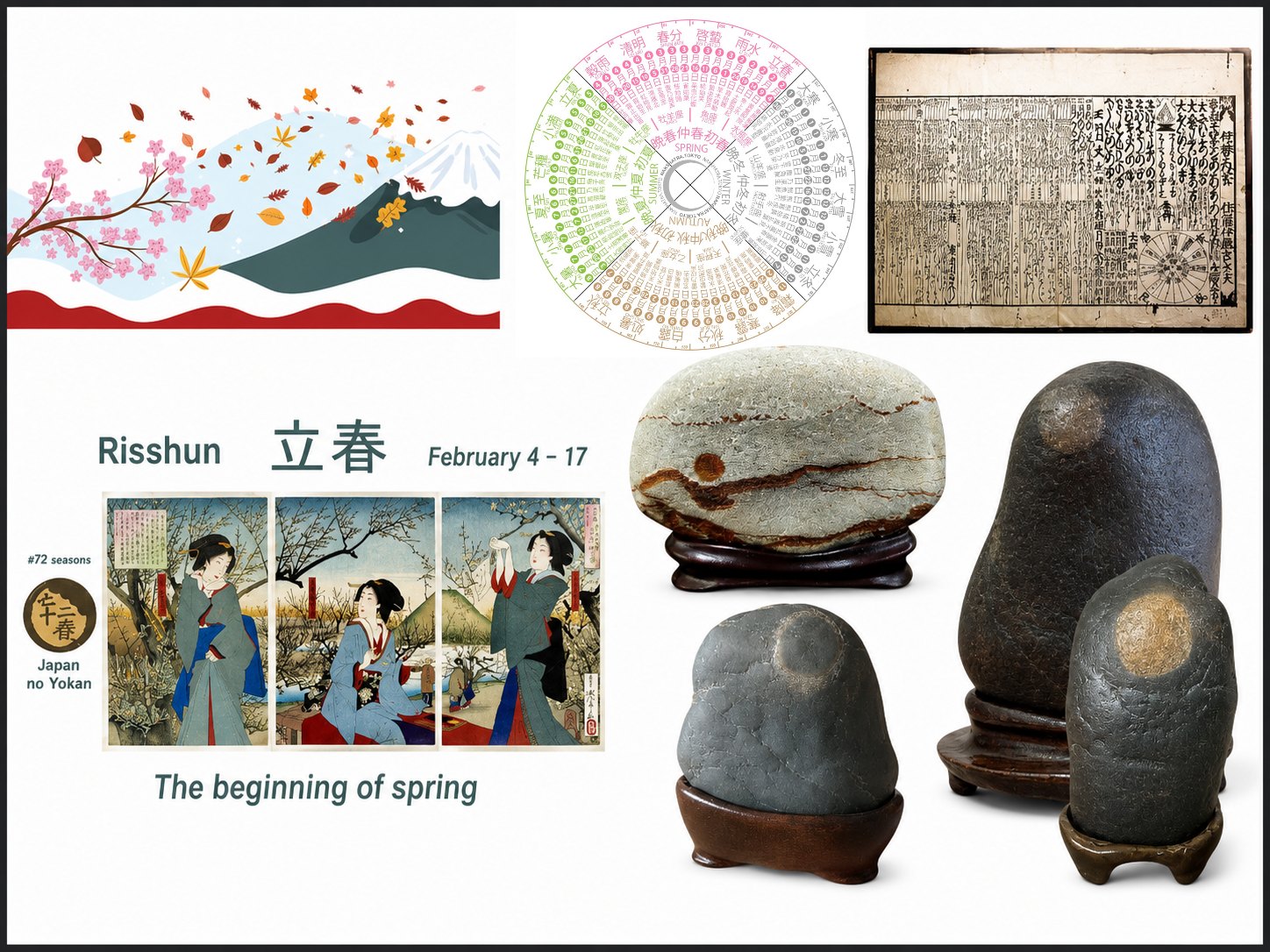
a) Seasonality: In Zen and the arts derived from it, nature is the central source of inspiration for all artistic expression. Nature follows observable cycles, studied through the science of phenology, which helps us understand the changing seasons and what we can expect to experience in the natural world. Recreating a seasonal scene is one of the most traditional and highly appreciated forms of display in Japan, where the traditional calendar recognizes seventy-two microseasons. If this approach is chosen, it is essential to understand these natural cycles thoroughly so that every element is combined accurately, faithfully reflecting nature without introducing anything that would not naturally occur.
b) Recreating a Landscape: If the objective is to compose a natural landscape, the display must remain faithful to nature. Nothing should be invented or artificially combined. A sound knowledge of natural processes, seasonal changes, habitats, and ecosystems is essential to create a convincing and harmonious composition.
c) Telling a Story: If this approach is chosen, the principal element—the suiseki—and every companion object must be selected with great care so that they perfectly support the story being told. Every element should be clearly connected, allowing the viewer to understand the intended narrative. When the display represents a personal experience or an event that may not be immediately understood by most viewers, it may be appropriate to include a small explanatory note placed discreetly beside the composition. Above all, every element must contribute to a coherent and meaningful story.
d) Symbolism: A symbolic composition requires thorough research into the idea or concept to be expressed. Once the symbolic message has been clearly defined, the appropriate elements should be carefully selected so that, together, they communicate that concept to the viewer. Because symbolic displays are not always immediately understood, they often benefit from a brief explanatory panel, unless the audience is already familiar with the subject. The explanation should simply help the viewer appreciate the intended meaning without distracting from the composition itself.
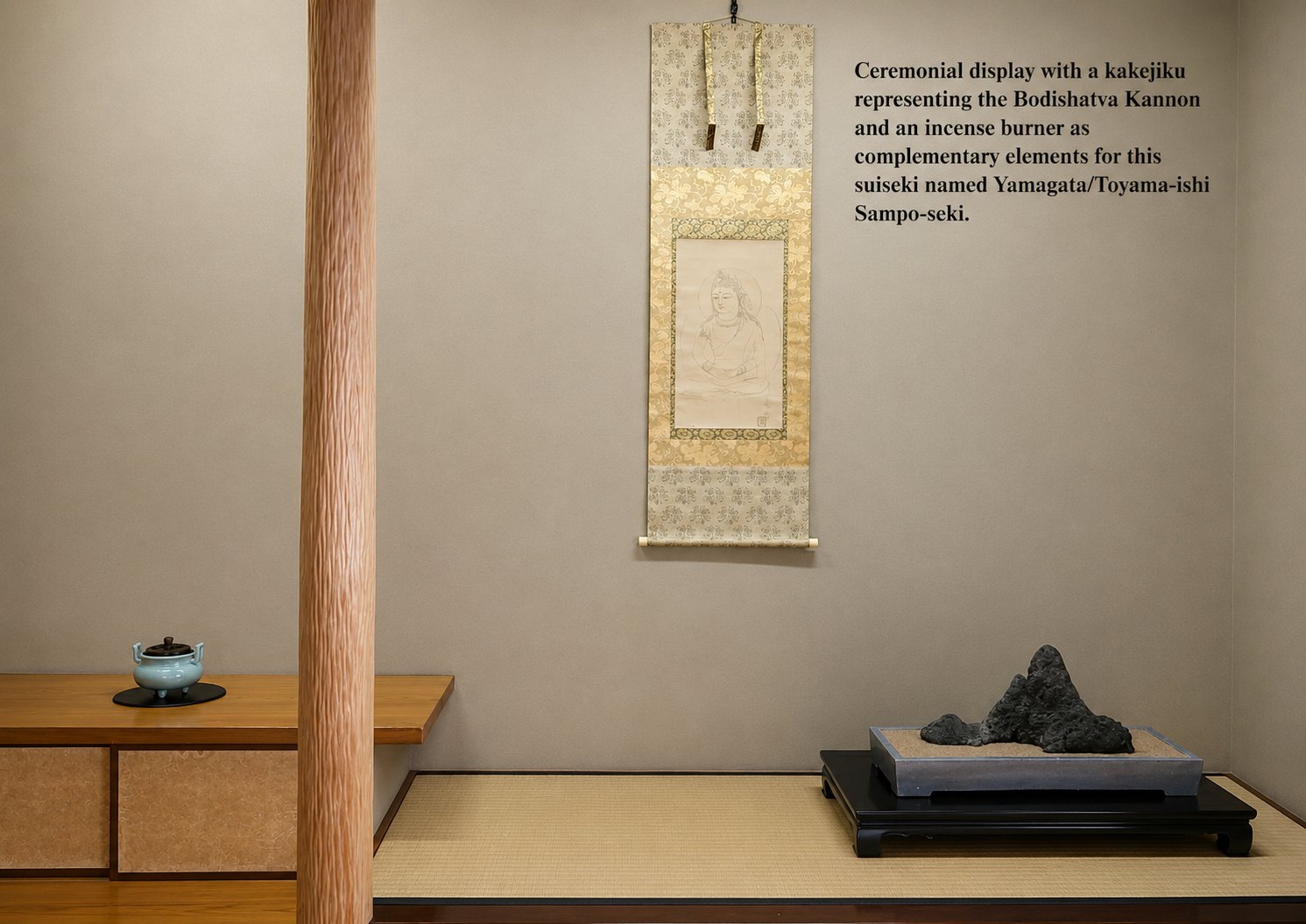
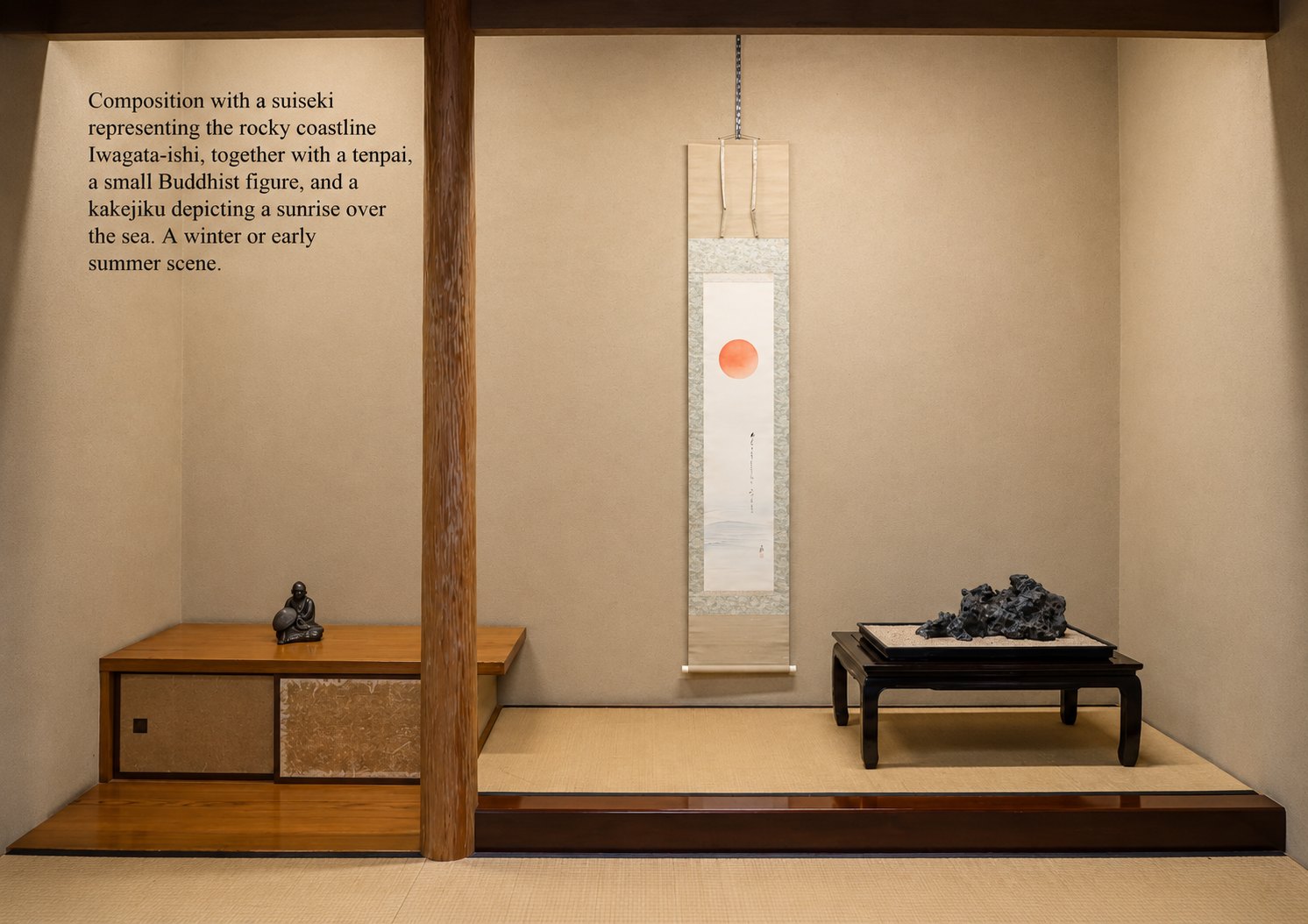
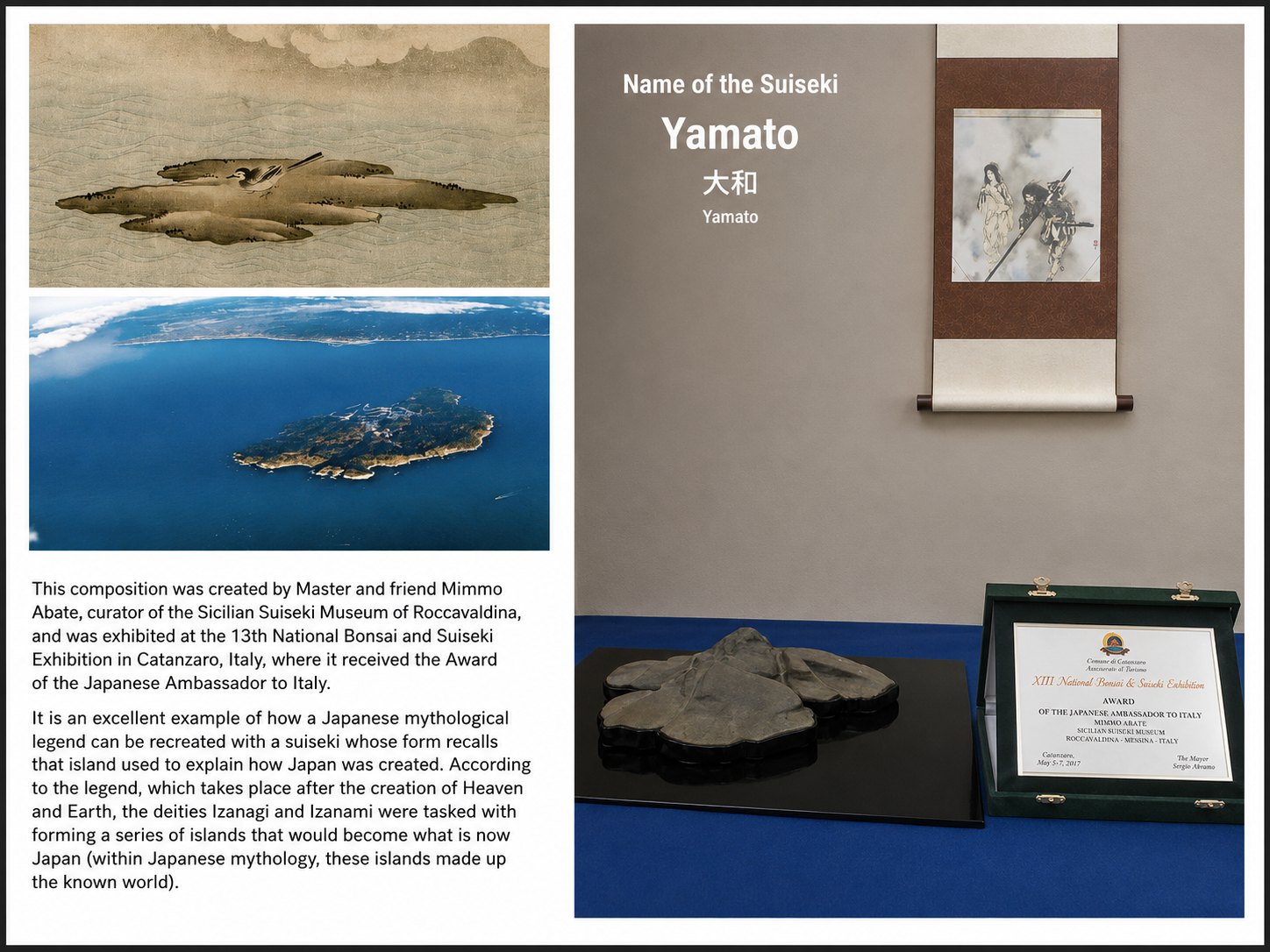
A remarkable example of symbolic display is the composition created by my friend, the Italian master Mimmo Abate, Curator of the Roccavaldina Suiseki Museum in Sicily. Presented at the 13th National Bonsai and Suiseki Exhibition in Catanzaro, Italy, it received the Award of the Ambassador of Japan to Italy.
This composition beautifully recreates a Japanese mythological legend through a suiseki whose shape evokes the sacred island associated with the creation of Japan. According to Japanese mythology, after the creation of Heaven and Earth, the deities Izanagi and Izanami gave birth to a series of islands that would eventually become the Japanese archipelago. This display is an excellent example of how a suiseki composition can successfully communicate a cultural narrative through symbolism while maintaining harmony and aesthetic balance.
Conclusion
So, what is a suiseki?
It is an artistic journey that transforms a viewing stone into a complete aesthetic experience within a display space. Even the most beautiful stone, full of decorative potential, will remain lifeless if it is not displayed with sensitivity and understanding. The way a stone is presented determines whether its intrinsic beauty is revealed or diminished.
The purpose of a suiseki display is therefore to create a harmonious composition in which every element contributes to a balanced, refined, and aesthetically pleasing whole. The same stone, arranged in different ways, can evoke entirely different impressions.
This is how we may understand the Way of Suiseki: a quiet and contemplative appreciation of nature, expressed through a viewing stone placed within a carefully composed display. Suiseki becomes the very essence of nature, elevated through artistic presentation into a work of dignity, harmony, and beauty within an aesthetic space.
Scope of This Article
The principles presented here are intended as an introduction to the traditional art of suiseki display. The complete methodology of Keidō Katayama-ryū is transmitted through formal study and practical instruction, and it therefore lies beyond the scope of this article.
Author
勝讓武古
Masaru Buko
(Marcial Yuste Blasco)
Marcial Yuste Blasco, known within the Keidō tradition by his gō (号) 勝讓武古 (Masaru Buko), is a researcher, educator and practitioner dedicated to the traditional Japanese arts of bonsai and suiseki. For more than twenty-three years he has devoted his life to bonsai, and for over fifteen years to the study and practice of suiseki. He is the founder and director of Sagunt-En, a Spanish traditional school whose mission is to study, preserve, teach and transmit these artistic traditions with fidelity to their Japanese cultural context.
His work is founded on the conviction that bonsai and suiseki are not merely aesthetic disciplines, but cultural expressions in which art, philosophy, ethics and the observation of nature converge. Through teaching, research, publications and international lectures, he seeks to foster an understanding of these traditions not as decorative practices, but as living paths of artistic cultivation and human development.
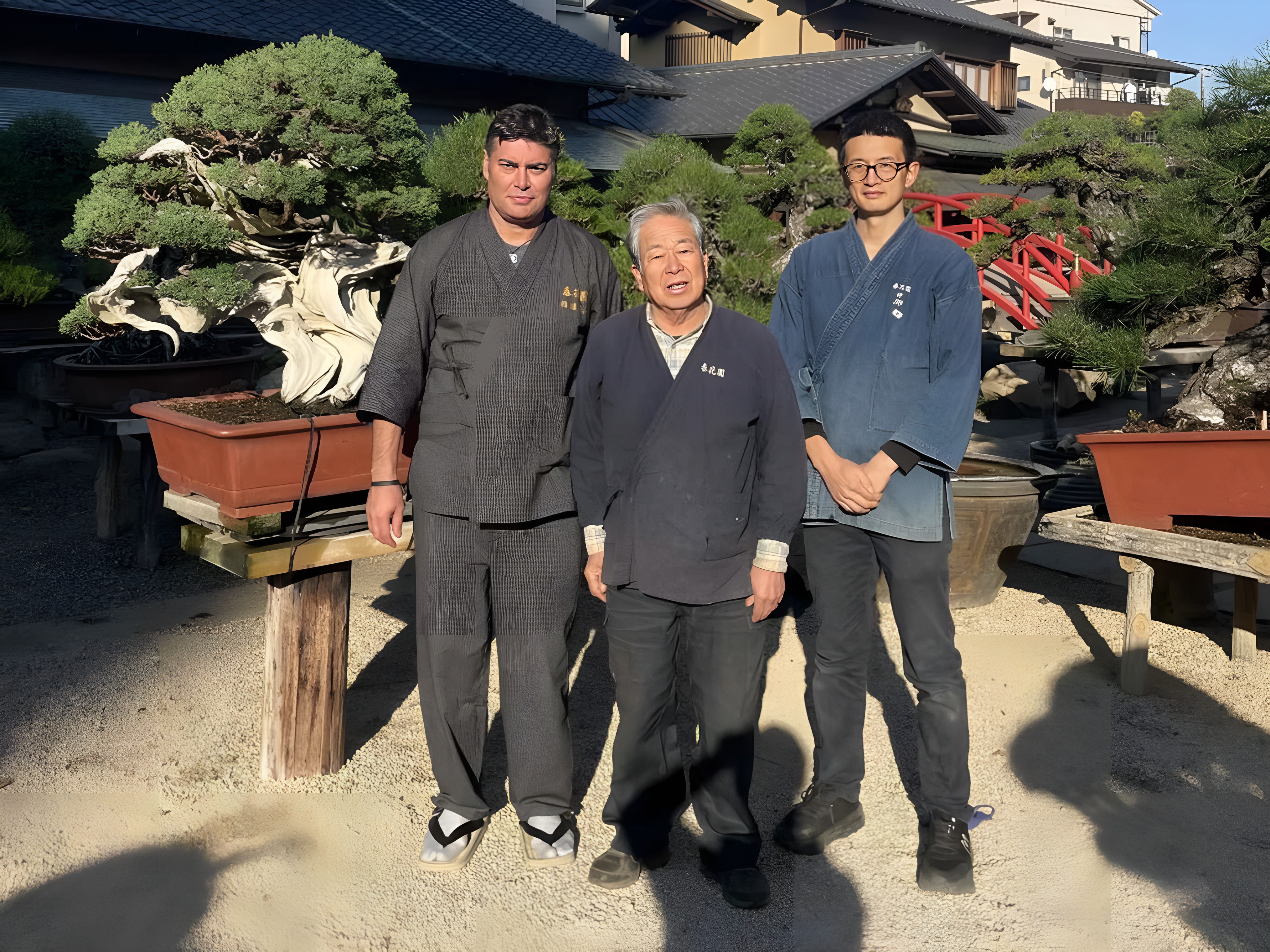
Since 2022, he has studied Keidō (景道, The Way of the Landscape) under the 3rd Iemoto, Kobayashi Kunio (Ippū), at the Shunkaen Bonsai Museum in Tokyo. In 2024, after successfully completing the traditional natori (名取) process, he was formally recognised as a disciple of the school and entrusted with a gō (号), the artistic name through which a disciple is recognised within a traditional Japanese lineage.
His gō, 勝讓武古 (Masaru Buko), was personally conceived by his senpai, Jin Yasufumi, not simply as a phonetic adaptation of his Spanish name, but as a name of ethical transmission. Each kanji was deliberately chosen for both its sound and its symbolic meaning, drawing upon principles found in classical Japanese literature, aesthetics and philosophy. Rather than functioning as an artistic pseudonym, the name embodies the responsibilities entrusted to him within the tradition. It reflects humility before achievement, selflessness over personal ambition, perseverance through lifelong discipline and the understanding that artistic mastery is inseparable from moral cultivation. Above all, it expresses the hope that bonsai and suiseki may increasingly be appreciated in the West as profound cultural traditions whose ultimate purpose extends beyond beauty to encompass character, contemplation and the transmission of values from one generation to the next.
Following this stage, his formal incorporation into the genealogical lineage (keizu, 系図) of the Keidō Katayama Ryū has been officially approved. During his forthcoming visit to Japan in October 2026, the traditional transmission ceremony will complete this process through ichiji hairyō (一字拝領), the centuries-old practice by which a master bestows upon a disciple a kanji belonging to the hereditary lineage of the school. Through this act, the disciple receives not merely a new name, but formal incorporation into the living genealogy of the tradition.
As part of this ceremony, he is scheduled to receive a hand-written kakejiku bearing his lineage name together with a makimono formally recording his admission into the school’s genealogical lineage. These documents represent the culmination of a path that began with the conferral of his gō through the natori process and complete his formal integration into a lineage transmitted continuously from master to disciple across generations.
Today, his work seeks to build a bridge between Japan and the West through the faithful transmission of the artistic, philosophical and ethical principles that have shaped bonsai and suiseki for centuries. Rather than presenting these disciplines solely as techniques or objects of aesthetic appreciation, he understands them as cultural inheritances whose deepest value lies in the cultivation of the individual. In this spirit, teaching becomes transmission, practice becomes study, and every composition becomes an invitation to contemplate nature not merely as landscape, but as a path toward inner refinement.
Acknowledgements
My deepest gratitude goes to my master, Kobayashi Kunio, 3rd Iemoto (Ippū) of the Keidō Katayama-ryū school, whose teachings and generosity have been an inexhaustible source of knowledge and inspiration.
Through him, I discovered a universe that extends far beyond the cultivation of a tree or the contemplation of a stone: the path of Keidō, where bonsai and suiseki attain their true artistic dimension by leaving the garden and the display shelf behind to become integral elements of a carefully composed exhibition space, such as the tokonoma.
It is within this dialogue between nature, space, object, and sensibility that genuine artistic expression is born: a composition capable of conveying balance, harmony, and emotion, connecting the human spirit with the essence of nature. Everything I have learned about the art of display and the creation of these aesthetic spaces is owed to my master, to whom I shall always remain profoundly grateful.
I would also like to express my sincere appreciation to José Manuel Blázquez for kindly allowing me to use several of his photographs to illustrate the relationship between the dimensions and proportions of suiseki and their artistic presentation.
My heartfelt thanks also go to Mimmo Abate for sharing with me his award-winning suiseki composition, recognized both in Italy and within Japanese cultural circles. His work stands as an outstanding example of sensitivity, balance, and abiding profound respect for the spirit of suiseki
